

Where Could the Next Bull Market Leadership Come From?
Every bull market has its leaders. But one of the more interesting patterns across market cycles is that the leadership rarely comes from exactly the same sectors as the previous cycle.
That pattern has repeated several times in India.
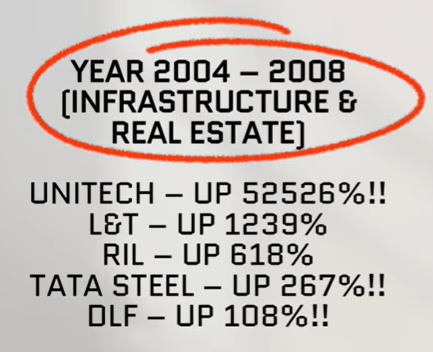
The 2004–08 bull market was dominated by infrastructure, real estate, metals and capital goods. Real estate, in particular, became one of the defining themes of the cycle. Stocks such as DLF and Unitech delivered extraordinary returns.
Unitech, for example, delivered something close to a 100x-type return between roughly 2006 and the market peak in 2008. In simple terms, an investment of ₹1 lakh could have become close to ₹1 crore over that period.
Then came a very different phase.
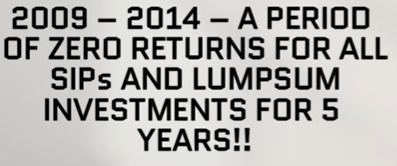
From around 2009 to 2014, the market went through a prolonged period of consolidation. To put that into perspective, an investor putting ₹10,000 every month into the Nifty for five years would have invested about:
₹10,000 × 60 months = ₹6 lakh
Yet by the end of that period, depending on the exact starting point and expenses, the value of that investment would have remained somewhere around ₹5–6 lakh.
In other words, investors kept investing, but the index itself went almost nowhere.
Then came the next major cycle.
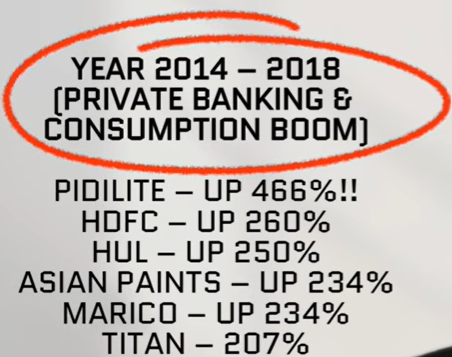
Between roughly 2014 and 2018, leadership shifted away from infrastructure and real estate and toward private banking and consumption.
Companies such as:
HDFC Bank, Hindustan Unilever, Asian Paints, Marico, Pidilite and Titan
became market favourites.
These were high-quality businesses with strong balance sheets, predictable earnings and long growth runways, and they delivered exceptional returns during the period.
After another slowdown, the post-COVID rally beginning in 2020 created yet another set of leaders.
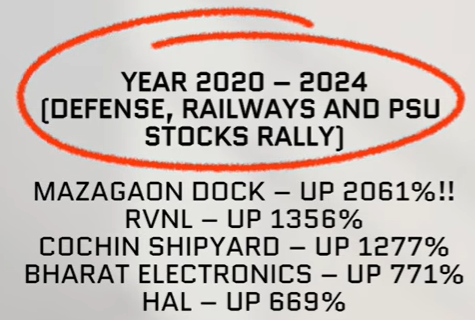
This time, the spotlight moved toward:
defence, railways and public-sector companies.
Stocks such as SJVN, NHPC, Power Grid, Coal India and ONGC had spent years trading at very low valuation multiples.
Several PSU stocks had been available at just 4x, 5x, 7x or 8x earnings, with some trading below 5x P/E.
Once the market rediscovered them, many of these stocks went up 3x or 4x.
The pattern is worth remembering.
Market leadership changes. The sectors everyone wants to own today are often not the sectors that lead the next major cycle.
That brings us to the question that matters now.
If the next bull market is beginning, where could the leadership come from?
Why the Current Market Setup Looks Interesting
Indian markets have gone through roughly two years of relatively flat performance.
That alone does not guarantee a bull market.
But there are a few reasons why the current setup deserves attention.
One interesting historical observation comes from an Edelweiss study examining 11 occasions since 2000 when markets delivered flat returns for roughly two years.
According to the study, in 11 out of 11 cases, the subsequent three-year period delivered positive annualised returns ranging between approximately:
7% and 30% CAGR.
Of course, historical patterns alone are not enough.
The more important point is what is happening underneath the index.
Corporate earnings have continued to grow.
For FY27, Nifty 50 earnings are expected to grow approximately 15% year-on-year.
During Q1 FY27 alone, Nifty 50 earnings reportedly grew around 18%.
At the same time, the broader economy has continued to expand, with reported GDP growth around 7.8%.
Automobile dispatch data also suggests strong demand.
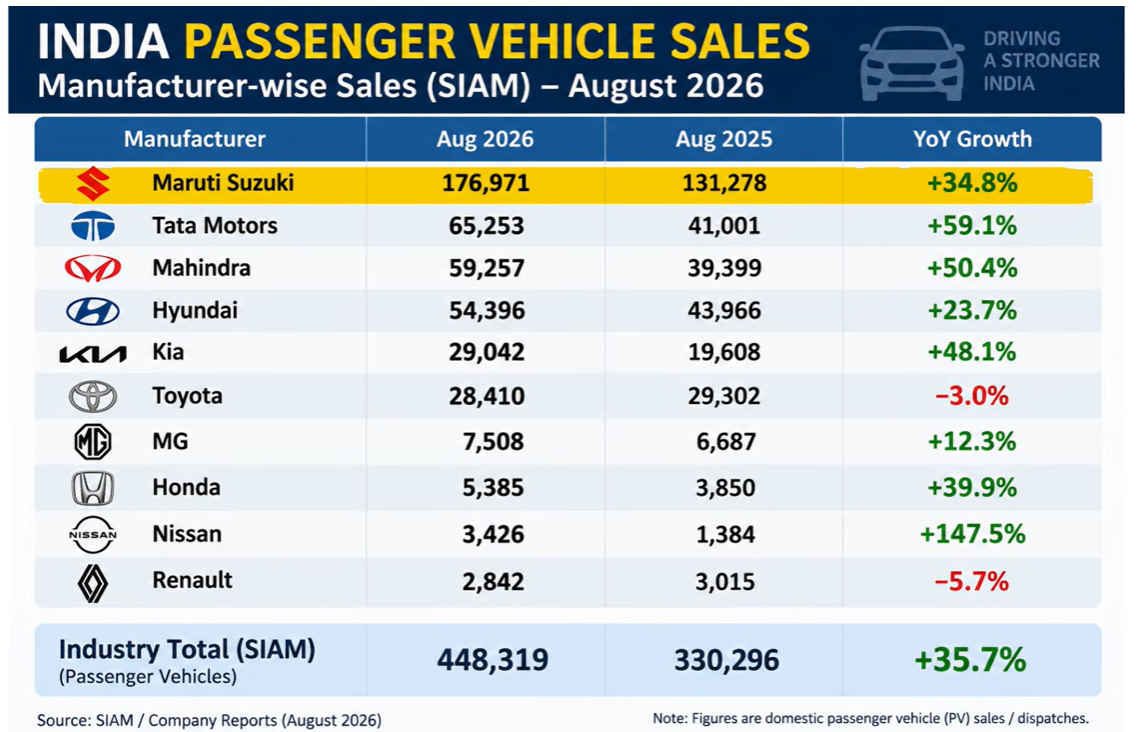
Recent year-on-year growth figures discussed in the video included approximately:
- Maruti Suzuki: +34%
- Tata Motors: +59%
- Mahindra & Mahindra: +50%
- Kia: +48%
These are dispatch numbers rather than final retail registrations, so dealer inventory must be considered. But they still indicate a substantial improvement in volumes.
Now combine that with the fact that the market itself has barely moved.
That creates an interesting valuation dynamic.
Remember:
P/E = Price ÷ Earnings
If stock prices remain flat while earnings keep growing, valuation multiples naturally fall.
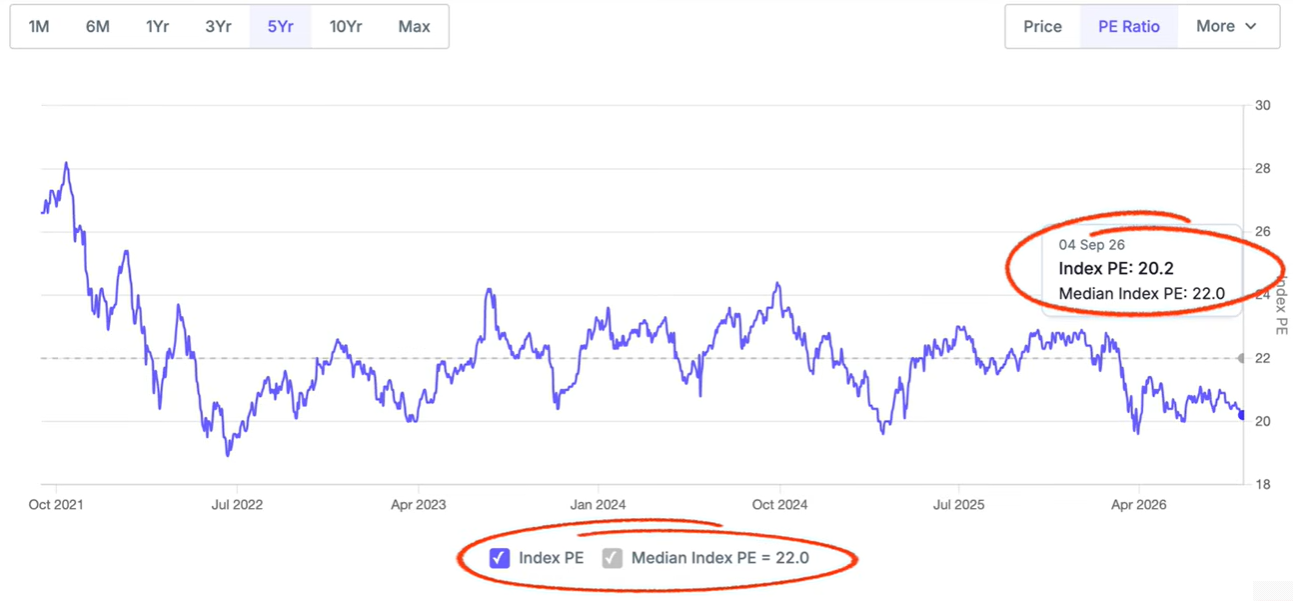
The Nifty is currently discussed at around 20.2x earnings, compared with a five-year average close to 22x.
That means the index is trading at roughly an:
8% discount to its five-year average valuation.
Compared with the three-year average, the discount is closer to:
10%.
So the starting point today is not simply “markets have been flat.”
It is:
prices have been flat while earnings have continued to grow.
That is a much more interesting setup.
Against that background, five sectors stand out.
1. Banking & Financial Services
If India is going to grow meaningfully over the next decade, banking and financial services almost certainly have to participate.
The current credit environment is already strong.
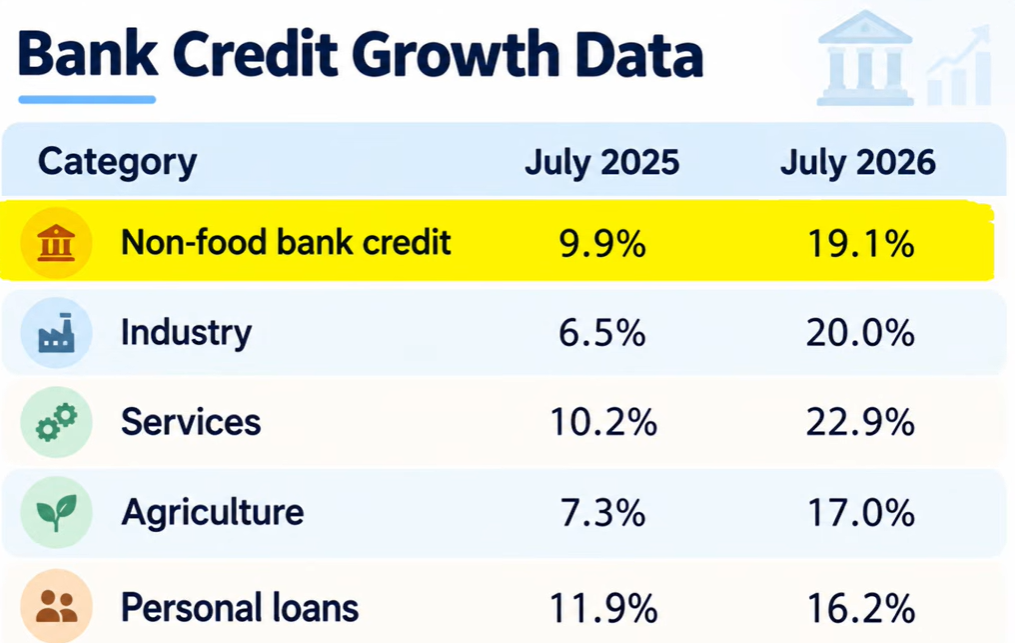
Non-food bank credit is growing around:
19.1% year-on-year.
Within that:
- Industry credit growth: ~20%
- Services credit growth: ~22%
- Agriculture credit growth: ~17%
- Personal-loan growth: ~16%
This is important because banks make money when credit grows while asset quality remains under control.
And the asset-quality environment today looks dramatically better than it did a decade ago.

Around ten years ago, parts of the Indian banking system were dealing with NPAs approaching or exceeding 10%.
Today, the overall banking system is significantly healthier.
That creates a useful combination:
strong credit growth + cleaner balance sheets + reasonable valuations.
HDFC Bank
HDFC Bank is one of the clearest examples.
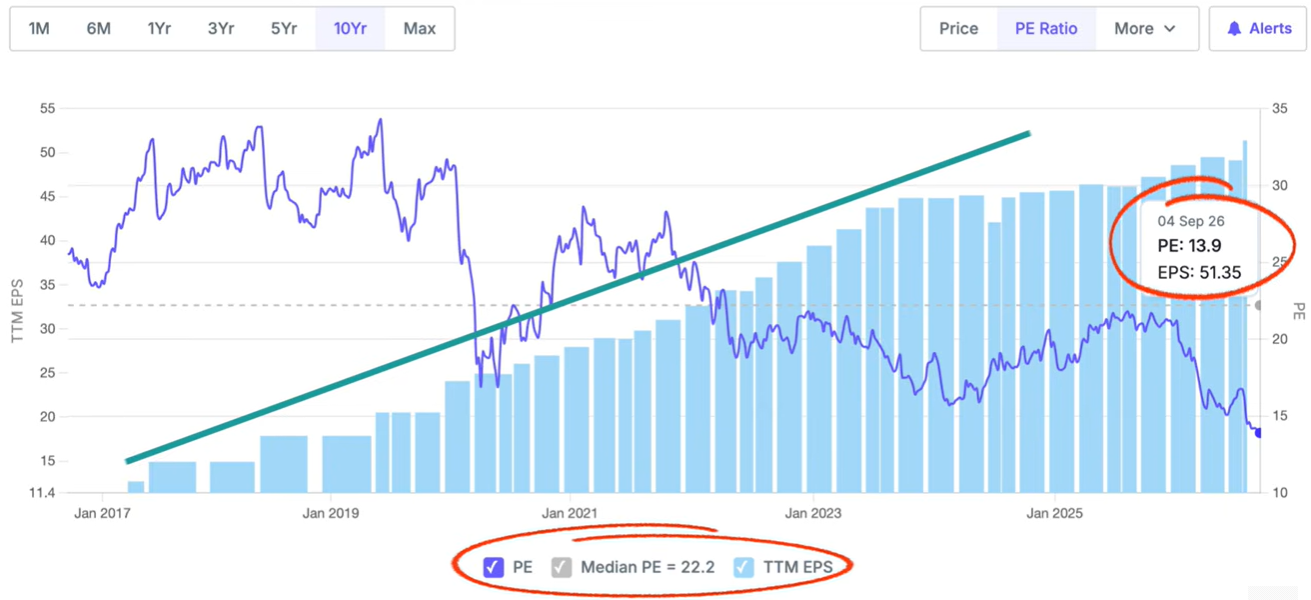
The stock is currently discussed at roughly:
13–13.5x earnings.
That valuation is approximately:
30% below its five-year average multiple
and roughly:
40% below its ten-year average multiple.
That is significant for a bank of HDFC Bank’s scale and systemic importance.
It is also worth remembering how broadly diversified the HDFC ecosystem has become.
Through the group, investors gain exposure to:
- banking,
- mortgages,
- asset management,
- insurance,
- and broader financial services.
The stock has also delivered relatively little return over the past five years.
Normally that frustrates investors.
But long periods of price stagnation can sometimes become interesting precisely because earnings continue to grow while investor expectations collapse.
HDFC Bank has also historically been among the most important stocks in the Nifty and Bank Nifty and remains a major institutional holding.
If foreign institutional flows eventually return strongly to India, large liquid financial stocks such as HDFC Bank are natural beneficiaries.
The key question is not whether HDFC Bank has been exciting.
It has not.
The key question is whether the gap between business performance and investor expectations has become sufficiently wide.
Tata Capital
Another interesting financial-services company is Tata Capital.
On the surface, Tata Capital looks like a traditional NBFC.
But underneath that is a growing technology-enabled lending platform.
One interesting part of the model is its API infrastructure.
Suppose a business wants to offer travel loans, consumer finance or another lending product.
Instead of building the entire lending architecture itself, it can connect to Tata Capital through APIs.
Customer data can pass through Tata Capital’s system, after which the loan may be originated, distributed or shared with banking partners.
Tata Capital may retain part of the loan on its own balance sheet and distribute the remainder.
The retained portion can sometimes earn relatively high yields, in the range of:
13–14%
depending on the lending product.
There is also a second structural advantage: the Tata ecosystem itself.
The Tata Group has around 26 listed companies, besides several other businesses across:
- automobiles,
- hotels,
- technology,
- aviation,
- consumer products,
- metals,
- manufacturing,
- and financial services.
That gives Tata Capital access to an unusually broad customer and distribution ecosystem.
The stock also came to the listed market after a period when grey-market expectations had been much higher.
Grey-market transactions had reportedly taken place around:
₹800–900
while the stock eventually listed around:
₹330–340.
That reset in expectations is worth watching.
Federal Bank
Federal Bank is another name worth following.
It has gradually built a reputation for relatively clean banking operations, improving profitability and transparent disclosures.
One useful point for investors trying to understand banking financials is that Federal Bank’s investor presentations tend to be relatively simple and detailed compared with many peers.
The broader sector argument remains straightforward:
India has strong credit growth, much cleaner bank balance sheets than a decade ago, and several established lenders still trading at valuation multiples below their historical averages.
That creates a potentially attractive starting point.
2. Information Technology: The Reverse AI Trade?
Information technology may be the most controversial sector on this list.
The dominant narrative today is:
AI will reduce the need for Indian IT services companies.
That may turn out to be only half the story.
Indian IT companies do not necessarily need to invent artificial intelligence.
They need to help enterprises implement it.
And that distinction matters.
Large corporations still need help with:
- integrating AI into existing systems,
- modernising legacy infrastructure,
- securing data,
- restructuring workflows,
- moving systems to the cloud,
- redesigning software architecture,
- and transforming business processes.
Indian IT services companies already specialise in exactly this type of enterprise transformation.
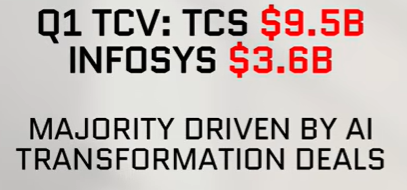
That is why the recent deal activity at companies such as TCS and Infosys is important.
TCS disclosed total contract value of approximately:
$9.5 billion
for the first quarter.
Infosys disclosed approximately:
$3.6 billion
of TCV.
A large share of these deals is related to digital transformation, cloud and AI-led programmes.
Infosys
For Infosys, around 60–70% of some recent deal wins were discussed as new business rather than simple renewals.
Geographically, the sector remains heavily exposed to developed markets, with roughly:
- 60% of business linked to the US
- around 30% linked to Europe
depending on the company.
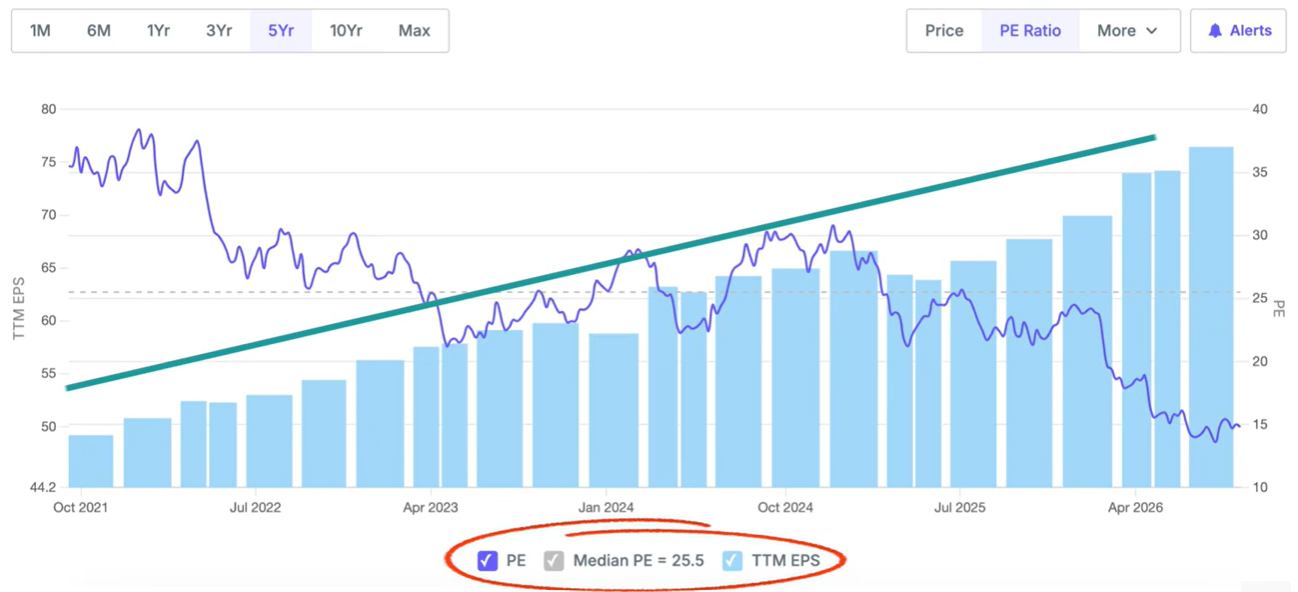
Revenue growth has also progressively improved across recent quarters.
The figures discussed moved broadly from around:
8.5% → 9% → 13% → 14%
across successive periods.
That matters because the market narrative has been that AI is destroying IT demand.
But the actual operating numbers suggest something more nuanced.
IT companies are increasingly winning AI-related transformation work.
That creates the possibility of a reverse AI trade:
The companies considered victims of AI may become major beneficiaries of enterprise AI adoption.
There is also a valuation argument.
At companies such as Infosys, EPS has continued rising while the valuation multiple has compressed.
That divergence cannot continue indefinitely.
Either earnings growth slows significantly, or the valuation eventually normalises.
The preferred large-cap names in this space remain:
Infosys and TCS.
For investors uncomfortable choosing individual companies, the sector may also be approached through an IT index or diversified technology fund.
One distinction is important, though.
Companies such as Dixon Technologies and Kaynes Technology often get grouped into the broader technology discussion.
But economically, these are primarily electronics-manufacturing companies, not traditional IT-services companies.
They may benefit from different structural trends, but the investment thesis is fundamentally different.
3. Power: The Opportunity May Be in Transmission
Global electricity demand is rising.
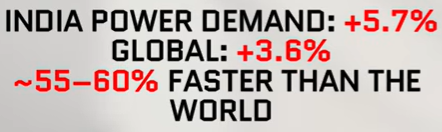
According to the figures discussed, global power demand is growing at approximately:
3.6% annually.
India’s power demand is growing closer to:
5.7%.
That means India’s electricity demand is growing roughly 55–60% faster than global demand.
The drivers are visible everywhere:
- manufacturing expansion,
- data centres,
- electric vehicles,
- rising air-conditioning penetration,
- urbanisation,
- household electrification,
- and renewable-energy additions.
But producing electricity is only one part of the equation.
Electricity must also reach where it is needed.
That makes transmission especially interesting.
Power Grid
Power Grid Corporation operates much like the highway network of India’s electricity system.
It does not primarily generate electricity.
It transports it.
Think of it this way:
Power producers manufacture the electricity. Power Grid owns the highways through which it travels.
Power Grid controls a very large share of India’s interstate transmission infrastructure, discussed at roughly:
80–85%
of the relevant transmission network.
Its revenues are relatively predictable because transmission is a regulated utility-like business.
The company earns returns from the infrastructure it builds and operates.
When a new transmission corridor is built — for example, from one large region to another — that new asset can become an additional stream of regulated revenue.
That makes the business partly annuity-like.
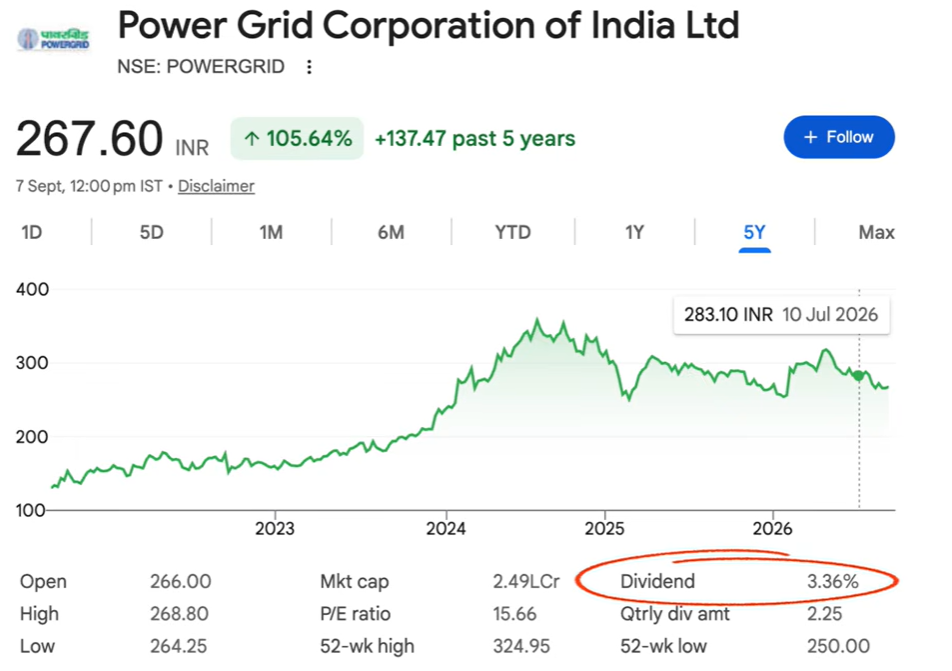
Power Grid also offers a relatively healthy dividend yield compared with many growth sectors.
The more interesting structural point is that transmission may remain a difficult business to disrupt.
Private players such as Adani Energy Solutions and Torrent Power are expanding, but entry barriers remain high because the sector involves:
- enormous capital requirements,
- regulation,
- long gestation periods,
- land and right-of-way issues,
- and government coordination.
As renewable capacity, manufacturing and data centres grow, transmission capacity must grow alongside them.
That creates a straightforward chain:
more electricity demand → more generation → more transmission infrastructure → larger regulated asset base.
NTPC
The second major power name is NTPC.
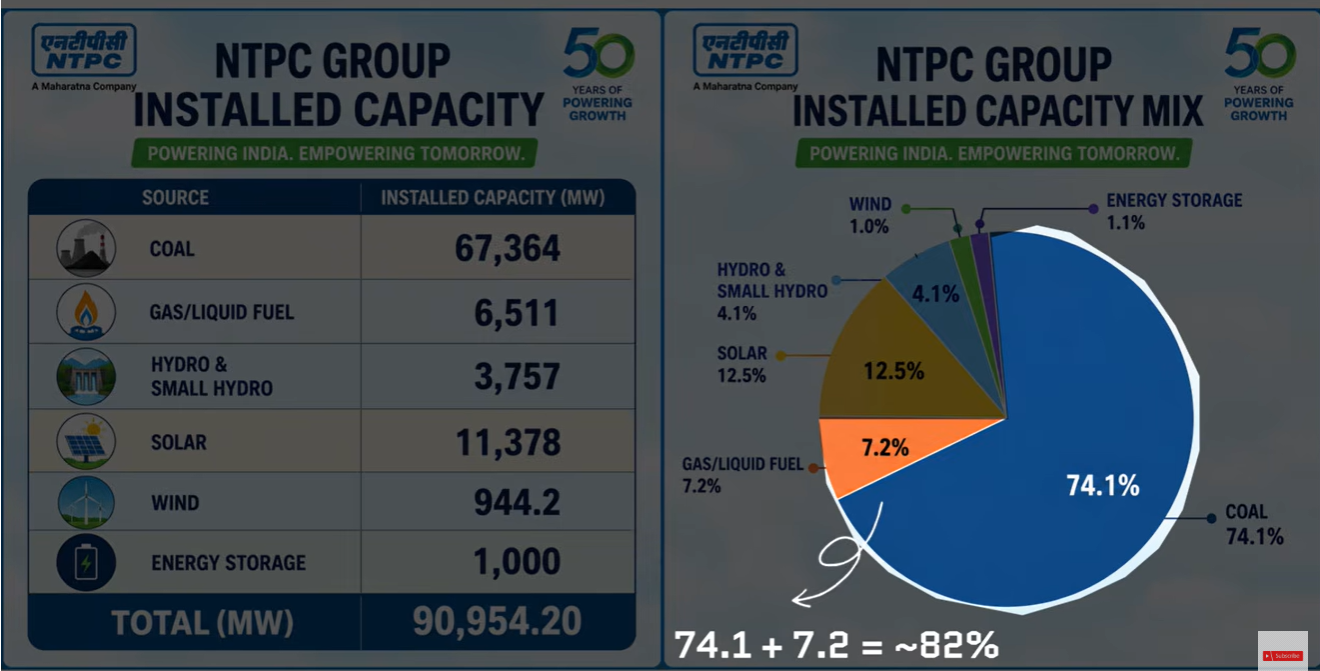
NTPC still generates roughly:
82% of its electricity from coal-based generation
according to the figures discussed.
That may appear unattractive in a market obsessed with renewable energy.
But that is precisely why valuation matters.
Companies such as SJVN, NHPC and Tata Power have already enjoyed substantial re-ratings because of investor enthusiasm around renewables.
NTPC, meanwhile, remains heavily exposed to India’s existing thermal power base while gradually expanding into renewable generation.
India cannot transition from coal to renewable power overnight.
Electricity demand continues to grow every year.
So the energy transition is more likely to look like:
renewables added on top of existing capacity
rather than:
coal disappearing immediately.
NTPC therefore provides exposure to both today’s electricity system and tomorrow’s transition.
4. Automobiles: Passenger Vehicles and the EV Transition
The recent improvement in automobile sales is difficult to ignore.
As discussed earlier, year-on-year dispatch growth included roughly:
- Maruti Suzuki: +34%
- Tata Motors: +59%
- Mahindra & Mahindra: +50%
- Kia: +48%
Within automobiles, passenger vehicles appear particularly interesting.
And within passenger vehicles, the long-term debate increasingly revolves around electric vehicles.
Tata Motors
Tata Motors today is effectively two different businesses.
Roughly:
80% of group revenue comes from Jaguar Land Rover
while approximately:
20% comes from the Indian passenger-vehicle business.
That makes the stock unusual.
Investors effectively get exposure to a global luxury-auto company through JLR and an Indian passenger-vehicle/EV franchise through Tata Motors India.
Jaguar Land Rover has faced several challenges:
- temporary production disruptions,
- a cyberattack,
- US tariff uncertainty,
- slower global demand,
- geopolitical uncertainty,
- and the expensive transition toward electrification.
But many of these are cyclical or transitional rather than permanent.
At the same time, Tata Motors has established an early leadership position in India’s EV market.
That creates two potential sources of upside:
JLR normalisation + Indian EV growth.
Mahindra & Mahindra
Mahindra & Mahindra is probably the most credible challenger.
Its SUV franchise is strong, its product pipeline has improved and the company is investing aggressively in electric vehicles.
The long-term passenger-vehicle leadership battle could increasingly centre around:
Tata Motors and Mahindra & Mahindra.
Maruti Suzuki remains the dominant company in conventional passenger vehicles, but it has historically moved more slowly into EVs.
The question for investors is therefore not simply:
“Who sells the most cars today?”
It is:
Who is best positioned for the next technological architecture of the automobile industry?
That makes Tata Motors and Mahindra particularly important names to track.
5. Pharmaceuticals: India’s Position Is Difficult to Replace
India remains one of the world’s most important pharmaceutical manufacturing centres.
A particularly important role is generic medicines.
The US healthcare system depends heavily on low-cost Indian generics.
That dependence matters.
Much of the recent concern around Indian pharma has been linked to possible US tariffs.
But pharmaceutical supply chains cannot be shifted overnight.
Generic-drug manufacturing requires:
- regulatory approvals,
- validated manufacturing facilities,
- quality compliance,
- supply-chain reliability,
- and scale.
Replacing established Indian suppliers quickly would be extremely difficult.
That creates structural resilience.
At the same time, several Indian pharmaceutical companies have gradually diversified away from excessive dependence on the US.
Sun Pharma
Sun Pharma has built one of the strongest pharmaceutical franchises in India.
Its business increasingly combines:
- a large domestic franchise,
- international generics,
- and specialty pharmaceuticals.
That diversification makes the company less dependent on any single market.
Zydus Lifesciences
Zydus Lifesciences is particularly interesting because more than:
40% of its revenue comes from India
according to the figures discussed.
That reduces the company’s relative dependence on the US compared with several peers.
It also gives investors exposure to India’s growing domestic pharmaceutical market.
Dr. Reddy’s and Cipla
Dr. Reddy’s Laboratories is another diversified pharmaceutical player that currently trades at comparatively reasonable valuations.
Cipla remains one of the strongest Indian pharmaceutical franchises, with exposure across domestic formulations, respiratory products and international markets.
The broader pharma thesis is therefore not simply “India exports cheap generics.”
It is:
India has built a pharmaceutical manufacturing ecosystem that major global healthcare systems cannot easily replace.
That is a structurally valuable position.
What About Defence, Railways and PSUs?
This is where the leadership-rotation argument becomes important.
Several defence, railway and PSU stocks have already delivered extraordinary returns.
That does not mean the businesses themselves are poor.
Defence spending, for example, remains a genuine long-term structural theme.
But valuation matters.
If a stock has already gone from:
5x earnings to 20x, 30x or more
the investment case becomes very different even if the business continues growing.
This is one of the easiest mistakes to make in a bull market.
Investors confuse:
a good story
with:
a good investment at today’s price.
The previous winners may continue growing.
But their starting valuations are no longer what they were before the rally.
That is why sectors currently considered boring may deserve more attention.
The Common Thread Across These Five Sectors
At first glance, banking, IT, power, automobiles and pharmaceuticals appear to have very little in common.
But from an investment perspective, they share an interesting pattern.
In many cases:
earnings are improving, but investor enthusiasm remains limited.
Or:
the business is evolving, but the share price has spent years doing little.
Or:
the sector has genuine structural growth, but another more fashionable part of the market has captured investor attention.
That creates the possibility of re-rating.
Think of the individual cases:
HDFC Bank:
Credit growth is strong, banking balance sheets are healthier and the stock trades well below historical valuation averages.
Infosys and TCS:
AI is perceived as a threat, yet enterprise AI transformation is creating large contract opportunities.
Power Grid:
Power demand is increasing, but transmission infrastructure remains less fashionable than renewable generation.
NTPC:
Investors prefer pure renewable stories, while India’s growing electricity demand still requires enormous conventional-generation capacity.
Tata Motors and M&M:
Passenger vehicles are recovering while EV adoption creates a new technology cycle.
Sun Pharma, Zydus, Cipla and Dr. Reddy’s:
Tariff fears weigh on sentiment even though Indian pharma remains deeply embedded in global healthcare supply chains.
These are different industries.
But the investment pattern is similar.
What History Suggests About the Next Market Leaders
Look back at the sequence.
2004–08:
Infrastructure, real estate, metals and capital goods.
2014–18:
Private banks and consumption.
2020 onward:
Defence, railways and PSUs.
Each bull market created a different set of heroes.
And almost every time, the sectors that eventually became obvious winners looked much less obvious at the beginning.
That may be the most useful framework today.
Instead of asking:
Which stocks performed best in the last three years?
A more productive question may be:
Where are earnings and fundamentals improving while valuations and investor expectations remain depressed?
On that framework, five sectors deserve serious attention:
Banking & Financial Services
Information Technology
Power
Automobiles
Pharmaceuticals
The individual companies discussed — HDFC Bank, Tata Capital, Federal Bank, Infosys, TCS, Power Grid, NTPC, Tata Motors, Mahindra & Mahindra, Sun Pharma, Zydus Lifesciences, Dr. Reddy’s and Cipla — are not guaranteed winners.
No company ever is.
But they represent areas where three things may increasingly be coming together:
improving fundamentals + relatively reasonable valuations + low investor enthusiasm.
And historically, that has often been a far more interesting starting point than buying the sectors everybody already loves.
