
In the recent Budget, the Finance Minister increased the Securities Transaction Tax on futures transactions from 0.02% to 0.05%. That is a 150% increase.
An indirect consequence of this, and probably not an intended one, will be felt by arbitrage mutual funds. Arbitrage fund returns are currently running at roughly 6% to 7%. We expect these returns to fall to somewhere between 5.5% and 6.5%, because the drag on arbitrage funds will be in the range of 0.3% to 0.5%.
So the natural question follows: have arbitrage funds become less attractive, and should you move to debt funds instead for your short-term parking needs?
Concept 1: Average Maturity and Modified Duration
Average maturity: the simple one
Suppose you own a bond fund that holds 10 to 15 different papers. Each bond has its own maturity profile. One bond might mature three years from now, another in ten years, a third in seven years.
Average maturity is simply the weighted average of those maturities, weighted by how much money sits in each bond. If that number works out to 7.5 years, it tells you that on average the portfolio matures in 7.5 years.
Useful, but not the number that should drive your decision.
Modified duration: the one that actually matters
Modified duration takes the average maturity and converts it into something far more practical. It tells you how much the fund’s NAV will move if interest rates change.
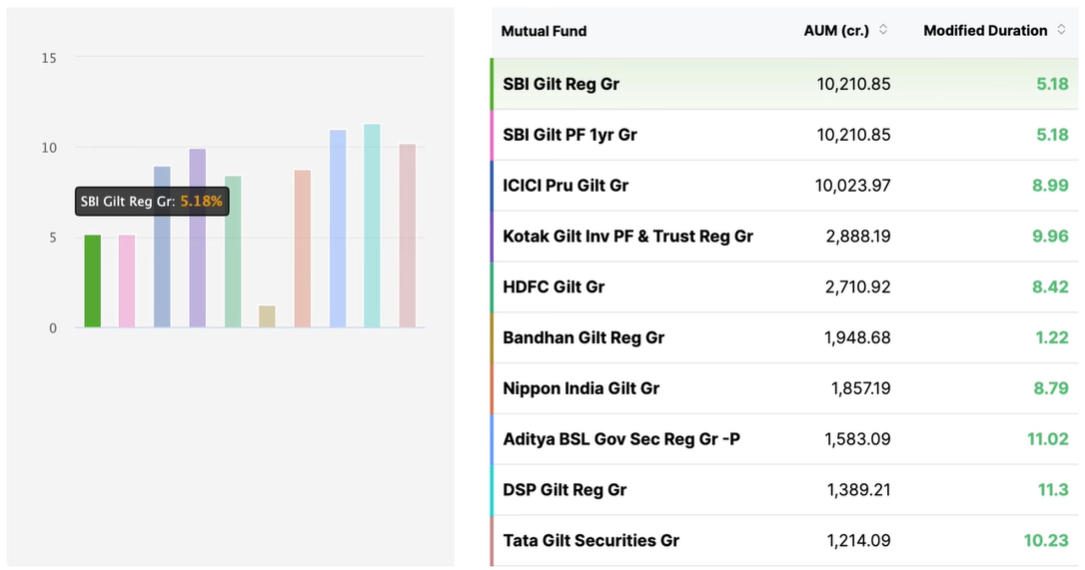
Look at the modified duration across gilt funds. SBI Gilt Fund sits at 5.18. ICICI is at 8.99. Kotak Gilt Fund is close to 9.96. Aditya Birla Sun Life Government Securities Fund is at 11.02.
Figure 1: Modified duration across gilt funds, compared with a liquid fund
The arithmetic is straightforward:
| The formula you need
Change in NAV = Modified Duration x Change in Interest Rates
If rates fall 0.25%, SBI Gilt Fund’s NAV rises by 5.18 x 0.25 = about 1.30%, and it happens almost immediately. If rates fall 0.50%, the same fund gains roughly 2.59%. Kotak Gilt Fund, at a duration of 9.96, gains close to 5%. And if rates go the other way, the fall is exactly as large. |
Here is the same calculation laid out across funds and across rate scenarios.
| Fund | Modified Duration | Rates fall 0.25% | Rates fall 0.50% | Rates rise 0.50% |
| Axis Liquid Fund | 0.12 (42 days) | +0.03% | +0.06% | -0.06% |
| SBI Gilt Fund | 5.18 | +1.30% | +2.59% | -2.59% |
| ICICI Gilt Fund | 8.99 | +2.25% | +4.50% | -4.50% |
| Kotak Gilt Fund | 9.96 | +2.49% | +4.98% | -4.98% |
| ABSL Govt Securities Fund | 11.02 | +2.76% | +5.51% | -5.51% |
Table 1: The same interest rate move produces very different outcomes depending on duration
Why does this happen?
It is simpler than it sounds.
When interest rates fall, older bonds become more attractive because they carry a higher coupon. If an old bond pays 9%, and the same company with the same credit rating now issues new bonds at 8.5%, everybody wants the old bond. Demand pushes its price up, and the NAV adjusts upward to reflect that 0.5% advantage.
When interest rates rise, the reverse happens. Investors sell the older, now less attractive bond and buy the new one. Prices fall.
| The rule to remember
Longer average maturity -> longer modified duration -> more risk. By risk we mean how much the fund falls if rates go up. But the reward is symmetric: if rates fall, the jump in price is just as large. |
Concept 2: Where We Are in the Interest Rate Cycle
This is where theory meets the calendar.
We do not see any major interest rate cuts over at least the next two years. Inflation is likely to show up over the next six to twelve months given everything unfolding around Iran. If anything, the probability of rates being revised upward is higher than the probability of them falling.
That is a significant reason why we would not consider buying bond funds right now.
What you earn if nothing changes
Every debt fund publishes a portfolio yield to maturity. That is roughly what you earn if interest rates stay exactly where they are.
| Fund | Average Maturity | Modified Duration | Portfolio YTM |
| Axis Liquid Fund | 45 days | 42 days | 6.36% |
| SBI Gilt Fund | Long | 5.18 years | 7.02% |
Table 2: If rates stay flat, this is broadly what you take home before tax
Liquid funds barely move with interest rates, because their modified duration is a matter of weeks rather than years. Gilt funds pay a little more, but you are being paid that extra 0.66% to carry a great deal of duration risk.
The 2023 Tax Change That Broke the Case for Debt Funds
Even if you were comfortable with the duration risk, there is a second problem, and it is the bigger one.
Until 2023, debt funds had a genuine tax advantage. If you sold three years after the date of purchase, you paid 20% tax on the profit after indexation. You marked up your purchase value using the inflation index, then paid 20% on what remained. Effective taxation used to land somewhere around 5% to 7%, depending on the index values for those years.
All of that is gone.
Today, debt funds are taxed at your slab rate regardless of how long you hold them. Hold for four years, five years, make 7% or 7.5% a year, and you still pay slab rate. If you are in the 30% bracket, you pay exactly what you would have paid on a bank fixed deposit or on the interest from an individual bond.
| The question worth asking
If a debt fund pays you roughly the same as a bank FD, and is taxed exactly like a bank FD, why would you accept credit risk and duration risk on top of it? |
Given the current tax regime around debt mutual funds and where we sit in the interest rate cycle, we do not see a single occasion where we would recommend debt mutual funds to our clients. We are not recommending them.
If you are in a high tax bracket at 30%, it obviously makes no sense. But even if you are in a lower bracket, why take on the kind of risk debt funds carry when individual bonds or a plain bank FD deliver much the same return?
The only scenario where the maths changes is if you are actively betting on interest rates falling and you intend to hold for ten years. And if you genuinely have a ten-year horizon, given where markets are, you should simply buy equities.
Debt funds are, to our mind, the least favoured product in the market right now.
How an Arbitrage Fund Actually Works
Arbitrage funds will deliver roughly 7% to 7.5%, and unlike debt funds, they are taxed as equity.
Just as modified duration, average maturity and portfolio yield are the numbers to watch in a debt fund, the number to watch in an arbitrage fund is the spread. The spread is the difference in price between the two markets, cash and futures.
The trade, step by step
- The fund manager buys a stock in the cash market. Say 1,000 shares at Rs 100 each, so Rs 1 lakh invested.
- At the same time, he sells the future of the same stock, expiring one month later, at Rs 102.
- That 2% difference is captured the moment both legs are placed.
- At month end, he simply delivers the 1,000 shares he already owns.
It does not matter whether the stock goes to Rs 200 or falls to Rs 50. He has locked in the 2%. All he has to do is give delivery of shares he is already holding.
This is why arbitrage funds are close to risk-free. We would put them roughly on par with bank FDs on safety. Compared with debt mutual funds, they carry far less risk, earn a similar rate of return if not more, and are taxed far more favourably.
The Taxation Point Most People Get Wrong
There is a persistent misunderstanding here that costs people money.
If you hold an arbitrage fund for longer than a year, you pay equity taxation on the gain. If you hold it for less than a year, say six or seven months, you pay short-term capital gains at 15%.
A lot of people assume that if they have to redeem in four or five months, they will be taxed at slab rate. That is not correct. You pay short-term capital gains, not slab rate.
| Debt Fund | Arbitrage Fund | |
| Held under 1 year | Slab rate (up to 30%) | 15% short-term capital gains |
| Held over 1 year | Slab rate (up to 30%) | 12% long-term capital gains |
| Indexation benefit | Removed in 2023 | Not applicable |
| Credit risk | Yes | Effectively none |
| Interest rate risk | Yes, via duration | Effectively none |
| Exit friction | Low | Low |
Table 3: The tax treatment is where the two categories separate decisively
And on the question of why not simply use a bank fixed deposit: if you need the money early, you have to break the FD and pay a penalty. Arbitrage funds are more tax efficient, and you can move in and out of them easily.
Where we stand today, unless you were confident that interest rates are going to fall by 25 to 50 basis points over the next year or two, which we do not see happening, the choice is arbitrage funds.
Which Funds We Prefer
Arbitrage funds
Most people pick the arbitrage fund with the lowest expense ratio. When you look a little deeper, the picture is different.
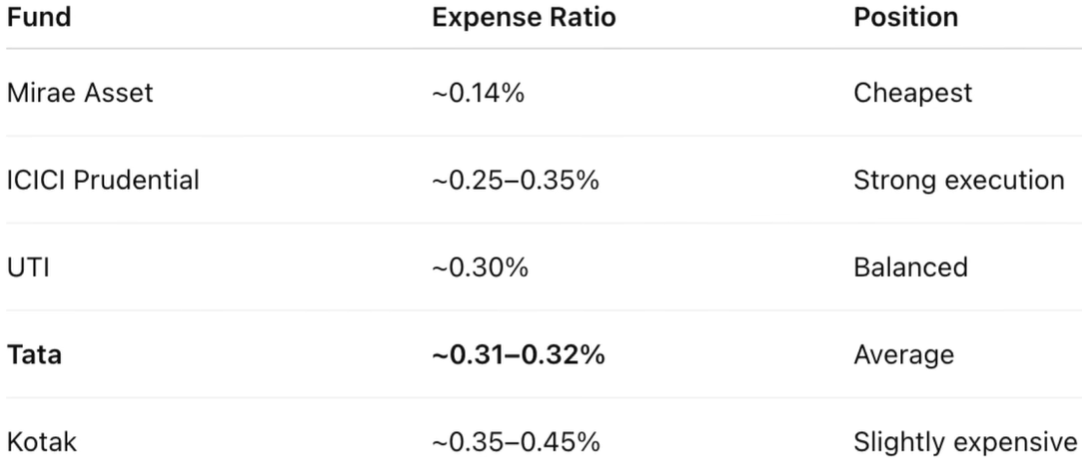
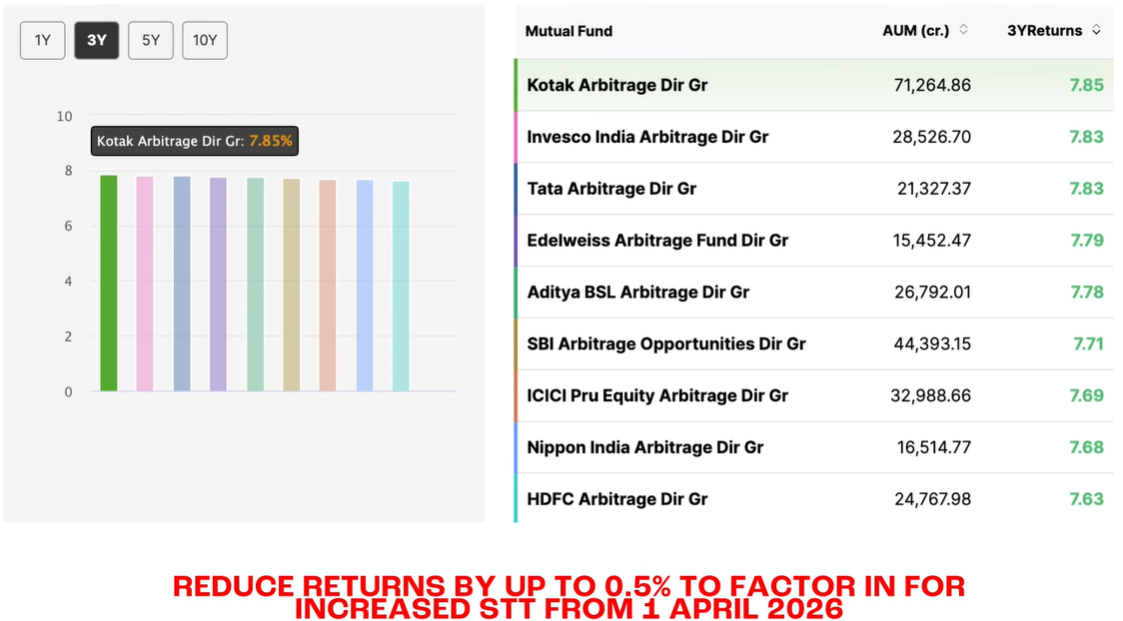
Mirae Arbitrage Fund has the lowest expense ratio at roughly 0.14%. Kotak sits at the higher end, somewhere between 0.35% and 0.45%. Yet on a three-year basis, and we always prefer to check three-year rolling or three-year returns for fixed income investments, Kotak Arbitrage Fund has delivered 7.85% CAGR. Mirae does not even feature on the list.
| Our recommendation
Choose from the top two: Kotak Arbitrage and Invesco Arbitrage. That is if you want to split across two funds to diversify. Quite frankly there is hardly any risk in arbitrage funds, so a single fund is perfectly reasonable. This holds whether you are parking money short term or expect to hold beyond a year. |
Debt funds
We do not see why, in this market, anyone would want to take on the additional credit risk of a debt fund when the return is broadly in line with an arbitrage fund or even a regular bank FD. If your financial advisor is pushing this to you, ask them the reason.
If for whatever reason you had to park money in a debt fund, choose a liquid fund. They are essentially treasury bills and are reasonably safe.
The One Situation Where We Would Buy a Debt Fund
The only time we would take exposure to a debt fund is if we believed interest rates were likely to fall, which we do not see happening for the next two years.
If we did hold that view, and wanted to buy and hold for ten years, we would choose a gilt fund. It is the safest category, and we would pick the one with the longest modified duration. Aditya Birla Sun Life Government Securities Fund has a modified duration of 11, which means it would generate significant alpha for the NAV if rates were to fall.
Keep in mind, however, that this fund has been underperforming precisely because interest rates have not been falling. With inflation rising and likely to rise further, there is every chance rates get revised upward, in which case this fund could fall sharply.
And it is not just this fund. Liquid funds, dynamic bond funds, short-term funds, overnight funds, every debt category would fall to some degree if rates go up, which to our mind is more likely than rates falling.
