

Will 2027 mark a turning point for Indian equities? We believe five major trends could shape investment returns over the next 12–18 months.
Indian equity markets have been under pressure, and investor sentiment has weakened considerably. In our previous market update, we cautioned that equities could correct by another 10%. Markets have already declined approximately 5% since then.
However, a market correction does not necessarily mean investors should exit equities. In fact, we believe the current environment presents an opportunity to gradually increase equity exposure, rebalance portfolios and accumulate fundamentally strong businesses that have remained out of favour.
Against this backdrop, here are our five big predictions for 2027.
1. Gold Could Make a Strong Comeback
We expect gold to perform well over the next 12–18 months, primarily driven by renewed central-bank purchases and growing concerns about the stability of the global financial system.
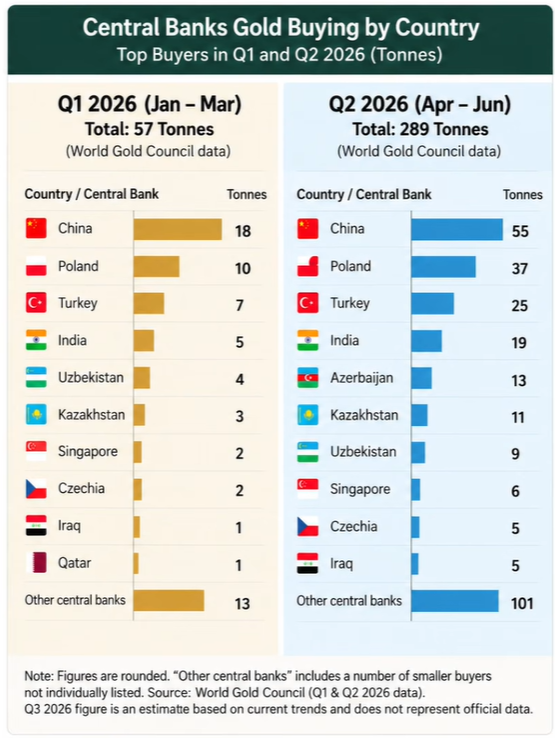
Central-bank gold purchases moderated during the first quarter of 2026 before recovering sharply in the second quarter.
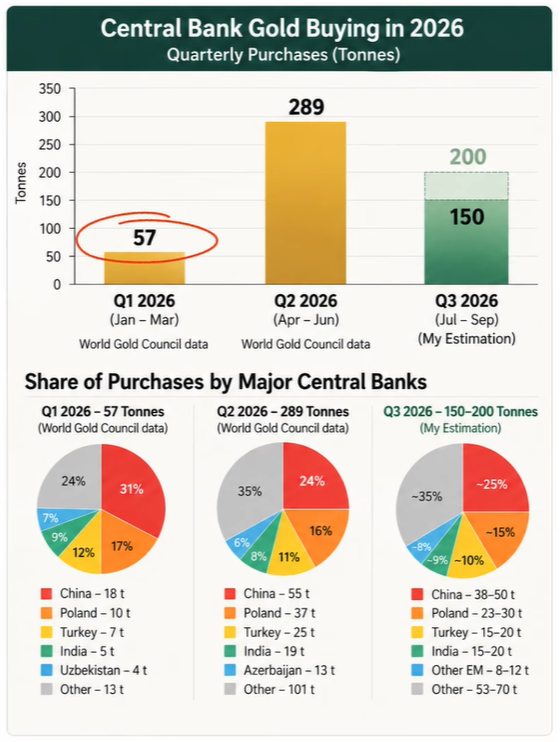
The figures discussed in our analysis suggest:
- Q1 2026: Approximately 57 tonnes of central-bank gold purchases.
- Q2 2026: Purchases increased to approximately 289 tonnes.
- Q3 2026: We estimate purchases could be between 150 and 200 tonnes.
A World Gold Council survey conducted between February and May 2026 also provides an interesting perspective. According to the survey figures cited in our discussion, approximately 89% of respondents expected gold prices to rise over the following 12 months, while 45% anticipated increasing their own gold holdings.
The structural argument for gold goes beyond inflation.
As geopolitical tensions increase and countries seek alternatives to the US dollar for international trade and reserves, gold could become an increasingly important strategic asset.
Our view: Gold is evolving from being primarily an inflation hedge to becoming an important hedge against financial and geopolitical instability. We believe investors should consider maintaining meaningful exposure to the asset class.
2. De-Dollarization Could Accelerate
Our second prediction is closely connected to the first.
We believe the world could witness an acceleration in de-dollarization over the next three to five years, with more countries attempting to reduce their dependence on the US dollar.
The United States has historically benefited from the dollar’s dominance in global trade and financial transactions. This has provided considerable flexibility in financing its deficits and debt.
However, increasing US government indebtedness, geopolitical conflicts and efforts by other major economies to develop alternative trade and payment arrangements could gradually challenge this position.
In particular, countries such as China and members of the European Union have incentives to diversify their economic relationships and reduce their exposure to US-led geopolitical uncertainty.
The transition will not happen overnight. The dollar’s established position in global trade and finance makes replacing it extremely difficult. Nevertheless, even a gradual shift could have significant implications for investment portfolios.
Where do we see opportunities?
We believe investors should pay closer attention to:
- Export-oriented Indian businesses with growing European exposure, particularly in textiles, leather, gems and jewellery.
- Domestic consumption-oriented companies with limited dependence on the US economy.
- Businesses benefiting from diversification in global trade relationships.
Companies heavily dependent on the US market may face greater uncertainty, although we see a potential exception in Indian technology services, which we discuss in our fifth prediction.
Our view: De-dollarization is a structural investment theme worth monitoring rather than dismissing as a distant possibility.
3. Nifty Could Be 20–25% Higher by December 2027
Despite the prevailing pessimism, we remain constructive on Indian equities.
Our central expectation is that the Nifty could be approximately 20–25% higher by December 2027 compared with its level at the beginning of October 2026.
This is a valuation-based expectation, not a guaranteed market target.
Three factors support our outlook.
Historical market patterns
Our analysis suggests that following periods when the Nifty has delivered flat or negative returns over two years, the subsequent three-year period has historically generated average absolute returns of approximately 62%.
While history does not guarantee future performance, prolonged periods of weak returns can create more attractive starting valuations.
Improving corporate earnings
Corporate earnings have begun showing signs of improvement.
During Q1 FY27 (April–June 2026), earnings increased by approximately 12%, according to the figures discussed in our market review.
If earnings continue growing at around 12–14% while stock prices remain stagnant or decline, equity valuations will progressively become more attractive.
Eventually, improving fundamentals can provide the foundation for a market recovery.
Potential reversal in market sentiment
Elevated crude oil prices, geopolitical uncertainty and expectations of higher interest rates have weighed on equity markets.
Interest-rate expectations have already been reflected to some extent in stock prices. If inflationary pressures ease or geopolitical tensions moderate, the improvement in sentiment could be rapid.
For instance, a meaningful ceasefire or easing of hostilities involving the US and Iran could trigger a sharp market rally, particularly if oil prices decline.
Our view: The next 12–18 months could prove rewarding for patient equity investors. Rather than attempting to identify the exact market bottom, we favour gradually accumulating fundamentally sound businesses at reasonable valuations.
4. Boring Large-Cap Stocks Could Deliver Surprising Returns
This remains one of our strongest investment convictions.
We believe some of the best returns over the next five years could come from large, established companies that have delivered disappointing stock-market returns in recent years.
Consider businesses such as:
- HDFC Bank
- Infosys
- Tata Consultancy Services (TCS)
- Power Grid Corporation
- Select pharmaceutical companies, including Zydus Lifesciences and Laurus Labs
These companies operate in established industries, and several have experienced extended periods of weak investor interest despite possessing substantial business franchises.
Why could that change?
One important factor is foreign institutional investor (FII) participation.
Historically, foreign investors have allocated substantial capital to India’s largest companies, particularly banks and information technology businesses.
As FII participation has weakened, several traditional institutional favourites have fallen out of favour.
We believe that whenever foreign capital flows recover, these businesses could become significant beneficiaries.
Moreover, many established companies are trading at valuations that appear more reasonable relative to their long-term prospects.
HDFC Bank is one example where we see the possibility of substantial long-term returns despite the stock’s lacklustre performance in recent years.
The larger lesson is that investors should not confuse recent share-price performance with future return potential.
Our view: Businesses that have gone nowhere for several years may offer better opportunities than stocks that have already experienced substantial appreciation. We see merit in looking beyond market excitement and focusing on earnings power, valuations and business quality.
5. The Reverse AI Trade Could Become a Major Investment Theme
Our final prediction concerns artificial intelligence.
We believe 2027 could witness the beginning of a reverse AI trade, where investment capital gradually shifts away from highly valued AI developers towards established technology companies that implement AI solutions.
This does not mean artificial intelligence will disappear or become irrelevant.
Rather, we believe the market may begin distinguishing more carefully between companies developing AI technology and businesses capable of generating sustainable profits from its implementation.
The valuation question
Significant amounts of capital are flowing into AI developers and infrastructure providers, often at extraordinary valuations.
With several major AI companies exploring public listings, investor enthusiasm could intensify further.
However, high valuations ultimately need to be supported by sustainable earnings and cash flows.
The growing interdependence of investments, partnerships and commercial arrangements within the AI ecosystem also deserves scrutiny.
AI adoption does not always translate into economic value
Our discussions with technology industry professionals suggest that some enterprise customers are reassessing their AI implementation strategies.
In certain applications, conventional software-development approaches remain more cost-effective or better suited to customer requirements.
For businesses, the relevant question is not simply whether AI can perform a task. It is whether implementing AI improves productivity enough to justify its costs.
Why Indian IT companies could benefit
This brings us to established technology services companies such as Infosys and TCS.
These businesses are not necessarily trying to develop the world’s most advanced AI models.
Instead, their opportunity lies in helping enterprise customers integrate AI into existing operations, modernise technology systems and improve business efficiency.
AI transformation projects are contributing to deal pipelines across the technology services industry.
However, investors must distinguish between total contract value (TCV) and revenue recognition. A large multiyear contract does not translate into equivalent revenue immediately; it is typically recognised over the contract period.
The key will be whether growing AI-related deal activity converts into sustainable revenue growth, margins and cash flows.
Our view: As investors become more selective about AI valuations, established technology service providers could attract renewed interest. We believe the next investment opportunity may increasingly lie with companies that implement AI profitably rather than those commanding extraordinary valuations for developing it.
What Should Investors Do Now?
Across these five predictions, one common principle emerges: the best investment opportunities may be found where current market sentiment is most disconnected from long-term fundamentals.
We believe investors should use market corrections to reassess their portfolios rather than react emotionally to falling prices.
Our preferred approach is to maintain a long-term perspective, gradually rebalance from fixed-income investments towards attractive equity opportunities where suitable, and prioritise business quality over short-term market momentum.
Sharp declines in individual stocks should also prompt a fresh assessment of their underlying fundamentals. Not every fallen stock is undervalued, and not every underperforming company deserves additional capital.
Meanwhile, maintaining appropriate gold exposure could provide diversification against geopolitical and financial uncertainty.
Final Thoughts
Our five predictions for 2027 are straightforward:
- Gold could regain momentum as central banks increase purchases and financial uncertainty persists.
- De-dollarization could accelerate, creating opportunities for businesses with diversified export markets and strong domestic exposure.
- Nifty could rise 20–25% by December 2027, supported by improving earnings and more attractive valuations.
- Large, overlooked companies could outperform, particularly in banking, IT and select pharmaceutical businesses.
- A reverse AI trade could emerge, favouring profitable AI implementation over speculative valuations.
Predictions are inherently uncertain. Geopolitical events, monetary policy and corporate earnings can change the outlook quickly.
Nevertheless, we believe the current market environment offers an opportunity to build a stronger portfolio for the coming years.
The objective should not be to predict every market movement correctly. It should be to own the right businesses at the right valuations and remain patient enough to benefit when fundamentals are reflected in stock prices.
