
Skipper sits at the intersection of one of the clearest infrastructure bottlenecks in the economy: the need to expand transmission capacity fast enough to keep pace with rising generation and power demand. India is entering a multi-year grid build-out, while transmission systems globally are also seeing under-investment and rising technical complexity. Skipper has spent decades building the manufacturing scale, engineering, testing, qualification and execution capabilities required to participate in this opportunity. With a large order book already in place and capacity expanding, the operating platform needed to capture that growth is already being built.
The earnings algorithm is simple: higher grid capex → more transmission tenders → more orders → higher plant utilisation → revenue growth and better fixed-cost absorption. If this is accompanied by a shift toward higher-value EHV/HVDC and export orders, margins can improve as well. At the same time, lower debt reliance and falling finance costs can allow PAT to grow faster than revenue.
Valuation
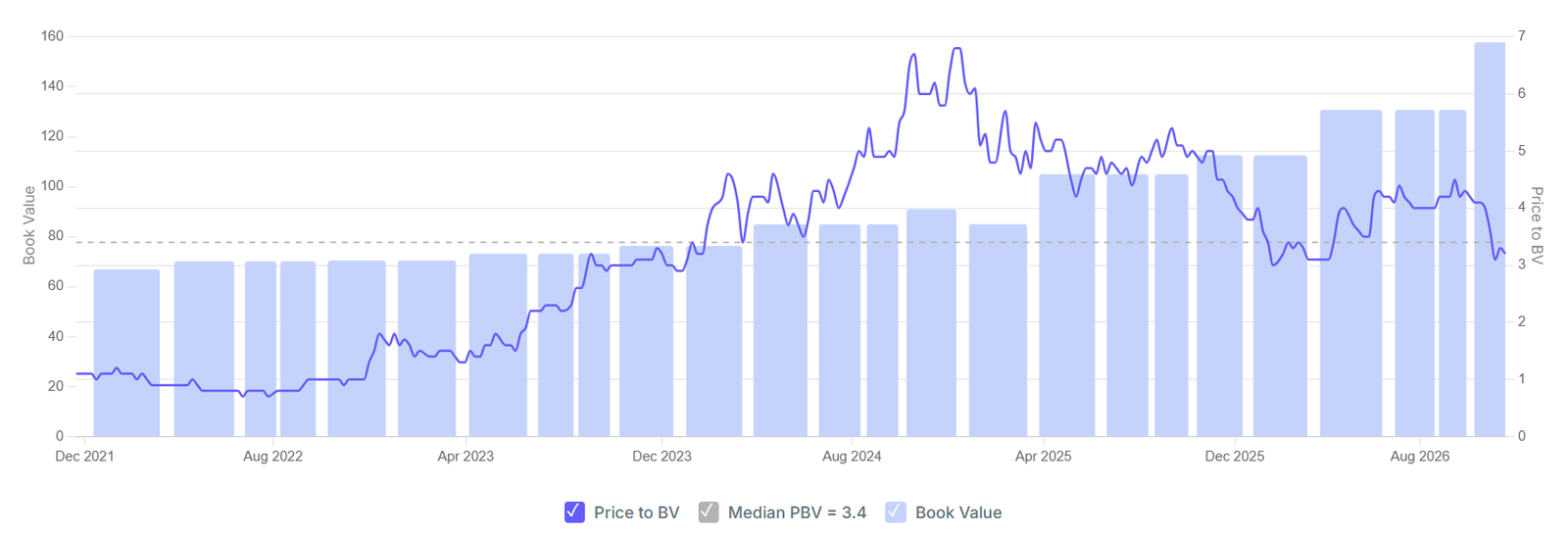
Skipper is currently trading at approximately 3.2x P/B, below its five-year median of 3.4x, implying a modest discount of around 6% to historical valuations. Despite a substantial improvement in book value over the past five years and a record order backlog providing strong revenue visibility, the stock continues to trade below its historical median multiple. Sustained earnings growth, improving return ratios and successful execution of its expanding export order book could support a valuation re-rating.
Why the Business Exists:
Electricity has no economic value if it cannot travel from where it is generated to where it is consumed. Solar and wind farms are increasingly built far from cities and factories, while new demand is concentrating around industrial corridors, EV charging and data centres. The grid is the bridge between those two maps.
| Electricity value chain | What happens | Skipper exposure |
| 1. Generation | Solar, wind, hydro and thermal plants make electricity. | No meaningful direct exposure. |
| 2. Step-up substation | Voltage is raised for long-distance transmission. | Substation EPC; structures. |
| 3. Transmission line | Power travels through high-voltage corridors. | CORE: towers, monopoles, poles, fasteners and T&D EPC. |
| 4. Step-down substation | Power is protected, routed and voltage is reduced. | Substation EPC and structures. |
| 5. Distribution | Power moves toward local users. | Selective poles/distribution EPC exposure. |
| 6. Consumption | Homes, factories and data centres use electricity. | No direct exposure. |
INDUSTRY STRUCTURE → WHY SKIPPER CAN BENEFIT
India Power Demand increasing at a breakneck speed while the global demand for power is growing at 3.6%, India’s Power demand is growing at 5.7%. For that reason
India is not merely adding more power generation; it must build the grid ahead of that generation. That creates a long-duration transmission order cycle. At the same time, the mix is shifting toward HVDC/EHV (EHV = Extra High Voltage /HVDC = High Voltage Direct Current) and more complex systems, which raises qualification barriers.
The investment case for Skipper is more transmission spend + higher technical complexity.
Transmission becomes the bottleneck
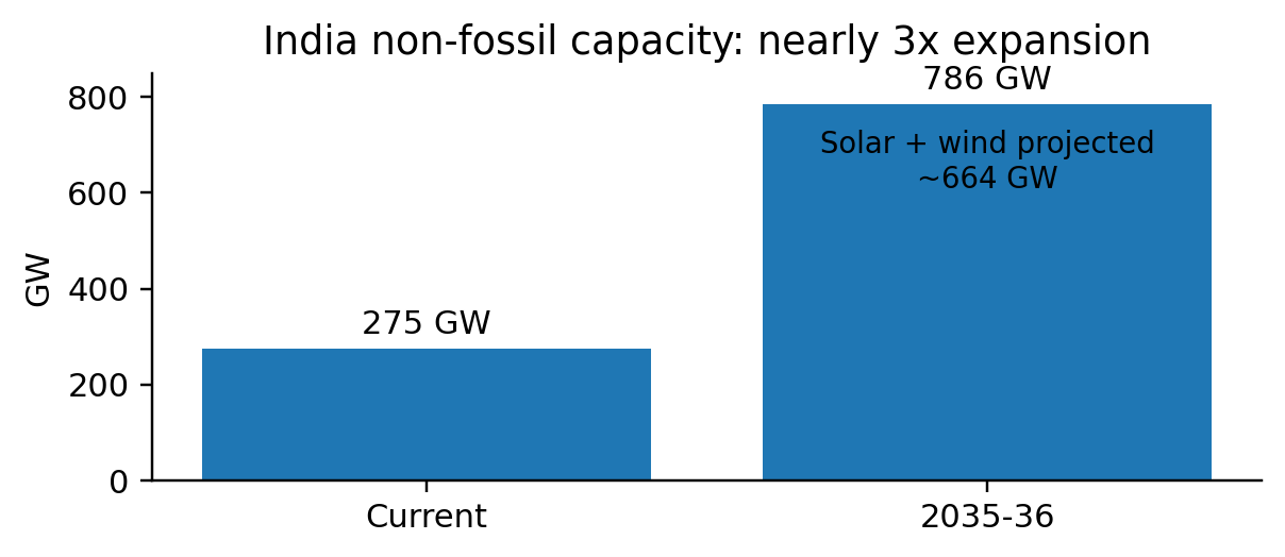
The energy transition changes the grid requirement. Non-fossil generation capacity is expected to rise from ~275 GW to ~786 GW by 2035-36, with solar + wind alone at ~664 GW. Peak demand is projected at ~459 GW. More generation located in renewable-rich regions must be moved to distant demand centres, so transmission becomes the enabling infrastructure rather than an optional add-on.
Key Capex Figures
|
₹7.9 lakh crore |
1,37,500 ckm | 8,27,600 MVA |
| Transmission investment opportunity | Planned transmission-line buildout |
Planned substation capacity |
THE BOTTLENECK: Generation and demand can appear faster than the network required to connect them. That makes qualified transmission manufacturing and execution capacity economically scarce during a grid build-out.
Adding renewable capacity is only half the job. A solar park in Rajasthan has little value to consumers elsewhere unless the electricity can be transported to them. Therefore, every major renewable hub creates a corresponding need for transmission lines and substations to carry that power into the grid. This makes transmission a necessary second leg of India’s energy transition, rather than a discretionary infrastructure spend.
Why This Bottleneck Favors Integrated Players Like Skipper
A transmission tower is steel, but a utility is not merely buying steel. It is buying an engineered structure that must satisfy voltage, wind-load, terrain, safety and utility-specific technical standards, then arrive in the right sequence so a line can be erected without delay. Qualification, testing references, fabrication quality, galvanising, project logistics and delivery reliability therefore matter alongside price.
Skipper’s relevance comes from integrating much of this chain: engineering and design, fabrication, galvanising, testing, fasteners and project execution. Integration gives the company more control over cost, quality and delivery than a pure fabricator.
Demand Visibility unusually long
|
40-45 GW |
→ | Grid planned ahead of generation |
→ | Multi-year tendering
|
→ |
Order visibility for |
Demand is also broadening beyond renewables to green hydrogen, data centres, EV manufacturing and industrial electrification.
The more important structural change: transmission is becoming complex
The opportunity is not only larger; it is becoming more engineering-intensive – shift toward HVDC systems, 1150 kV ultra-high-voltage corridors and storage integration (BESS / PSPs). As project complexity rises, the pool of qualified suppliers narrows.
|
Industry shift |
Skipper’s stated fit | Investment implication |
|
HVDC (High Voltage Direct Current) / EHV (Extra High Voltage) / higher system complexity |
Tower-manufacturing scale + R&D / EHV focus | More value shifts from basic fabrication toward qualification, engineering and reliable execution. |
|
Transmission ordered ahead of generation |
Scale advantage + EPC execution capability |
Front-loaded tendering can translate into a longer order runway for capable suppliers. |
| Large pan-India grid buildout | Cost leadership + national transmission alignment |
Scale and cost discipline become more valuable as volumes rise. |
| Global grid capex + China+1 | Developed-market export push in transmission & telecom |
Exports can become a second growth engine and reduce dependence on one geography. |
The transmission demand is becoming larger and more technically complex at the same time. That combination increases the economic value of scale, cost position, qualification, engineering capability and execution – exactly the areas in which Skipper says it is strengthening
The Business Model
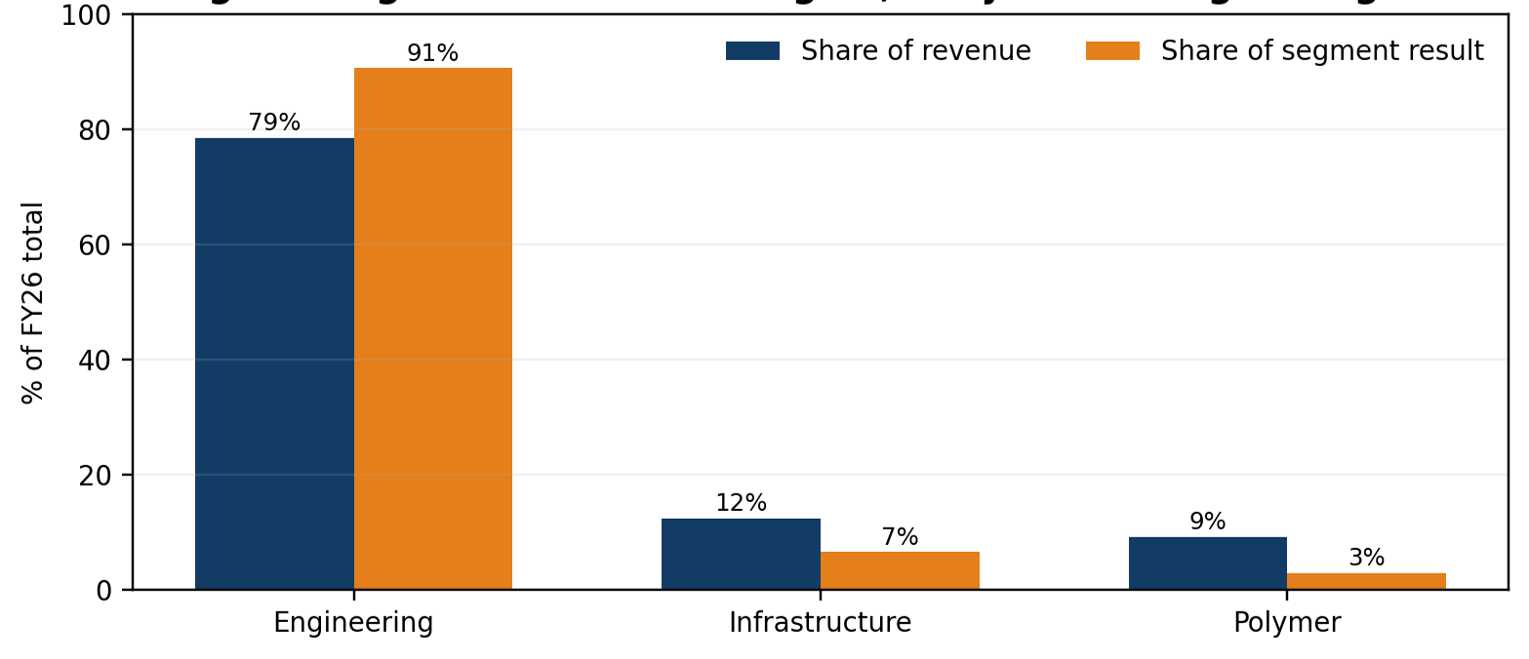
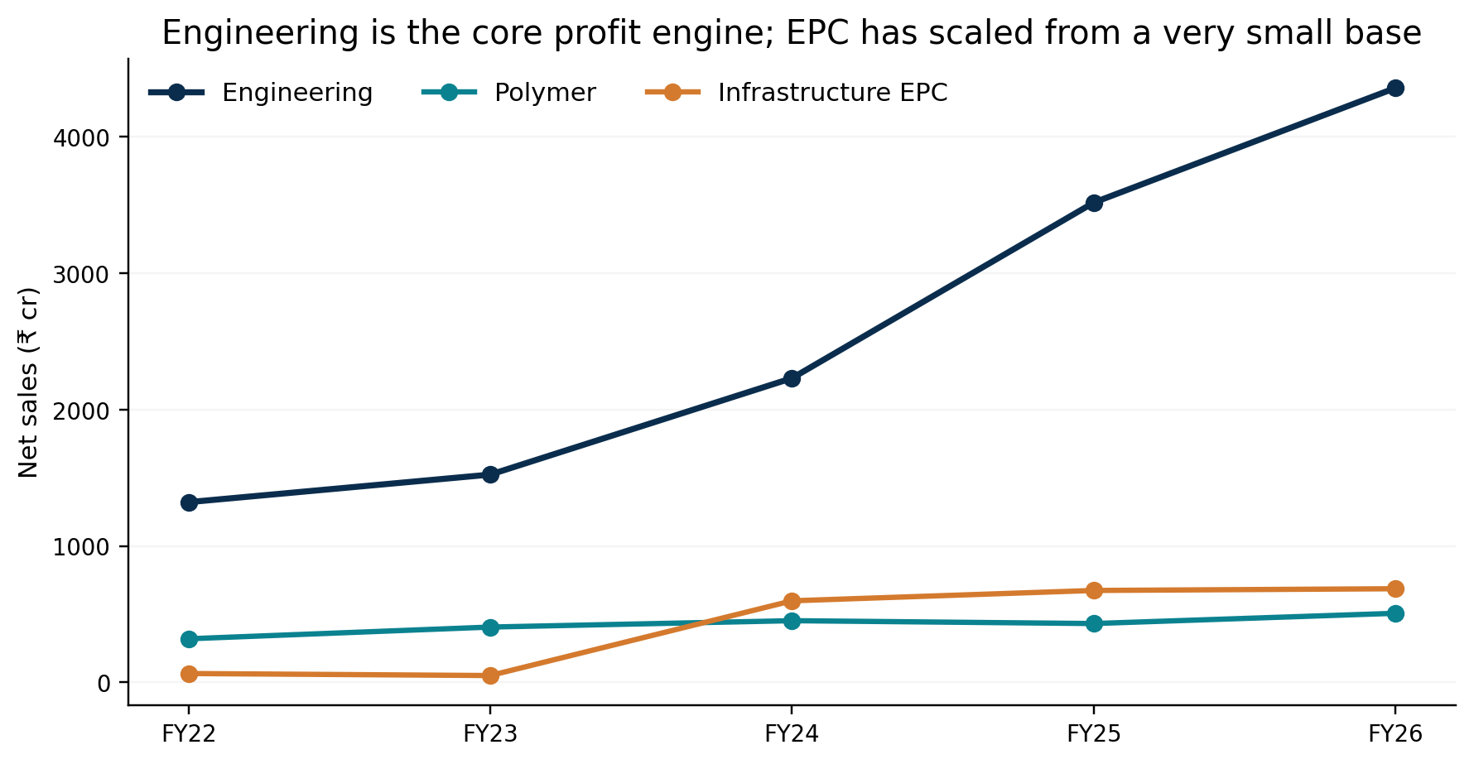
Skipper reports three segments, but they do not contribute equally to economics. The Engineering Products division is the franchise. Infrastructure EPC helps Skipper participate in turnkey projects and pull its manufactured products through the value chain. Polymer provides diversification, but it is a much smaller and lower-margin business.
|
Vertical |
FY26 revenue | What it sells | Investment role |
|
Engineering Products |
79% | Transmission towers, monopoles, poles, fasteners, telecom/rail/solar/wind structures. | The earnings engine: ~91% of FY26 segment result. |
| Infrastructure EPC | 12% | Transmission EPC, substation EPC and telecom EPC. |
Forward integration; helps win turnkey work, but is more working-capital intensive. |
| Polymer Products | 9% | PVC/CPVC/HDPE pipes and fittings. |
Diversification; materially lower segment margin than Engineering. |
|
Segment |
FY26 sales | EBITDA margin |
|
Engineering |
₹4,359 cr | 11.7% |
| Infrastructure EPC | ₹687 cr |
6.0% |
| Polymer | ₹507 cr |
4.2% |
- Engineering: Skipper wins product orders, buys steel/zinc and other inputs, fabricates and galvanises structures, then supplies them to utilities/EPC customers. Utilisation and product mix are critical to margins.
- EPC: revenue is recognised as project work progresses, but cash can arrive later because payments are milestone-based and customers retain part of the amount. This is why order-book growth can consume working capital.
- Polymer: a conventional branded pipe-and-fittings model through distributors/retail channels.
Why Skipper Can Win
Power T&D is a tender-driven industry, so there is no monopoly moat. Skipper’s advantage is better described as a capability stack: long operating history, high-voltage references, integrated manufacturing, testing capacity, utility approvals and the financial ability to execute large contracts.
The capability stack turning into higher orders
- 45+ years of operating history and established relationships with utilities and infrastructure customers. CRISIL specifically cites the company’s established T&D market position and clientele.
- Backward integration in towers and poles: more of the critical fabrication chain is under Skipper’s control, supporting quality, delivery and operating margin.
- Testing and qualification: the company has built dual test-bed capability and completed audits by potential customers across developed markets, which matters because export utilities qualify vendors before awarding high-voltage work.
- High-voltage execution references: the company says it is executing roughly 5,200 circuit-km of EHV/HVDC work as of Jun-2026. References compound because successful execution improves eligibility for the next tender.
Orders: demand has already converted into backlog
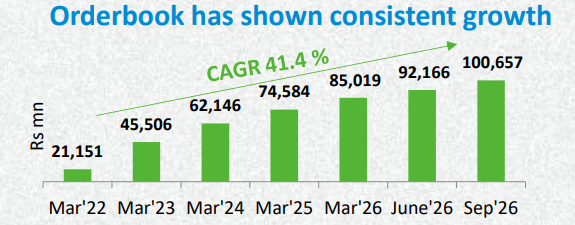
Record closing order book: ₹100,657 Mn; up by 18.4 % over March 2026 Level, reinforcing strong revenue visibility. Management says typical orders execute over 2-2.5 years and expects around ₹5,000 crore of the existing backlog to execute during FY27, supplemented by shorter-cycle orders.
Mix: will the next rupee of revenue be better?
This is the most important upside lever after volume. Skipper is trying to increase the share of higher-voltage T&D work and developed-market exports. In FY26 engineering exports were about 16% of engineering revenue and total company exports were about ₹710 crore. Management’s long-term ambition is far larger: roughly 50% of transmission-tower product revenue from exports and 12%+ consolidated EBITDA margin.
Higher-complexity work can carry better realization and reduces the relevance of pure conversion-cost competition. Developed-market qualification also raises the cost of entry because customers require audits, approvals, testing and delivery history.
The export opportunity is beginning to materialise. Export orders now account for 17% of Skipper’s September 2026 order book, nearly doubling from 9% in June 2026. This marks an encouraging shift from a predominantly domestic order book toward greater international diversification. While the improvement provides early evidence of the export strategy gaining traction, sustained execution and conversion into revenue will be key to establishing exports as a meaningful growth driver.
Growth Triggers: What Can Move Earnings Over the Next 24-36 Months
Trigger 1 – Capacity commissioning
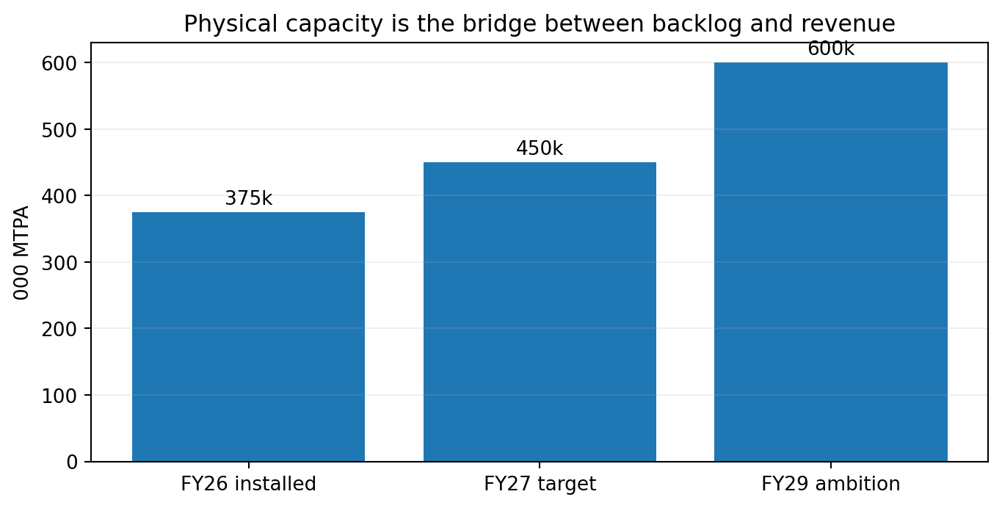
The additional 75k MTPA under execution takes installed engineering capacity toward 450k MTPA. If demand remains strong, more sellable tonnes create operating leverage because the engineering platform already carries fixed plant, testing and design costs.
Trigger 2 – Order-book conversion
Record closing order book: ₹100,657 Mn; up by 18.4 % over March 2026 Level, reinforcing strong revenue visibility. The important KPI is not the headline backlog alone, but whether execution grows without margin dilution or a working-capital blowout.
Trigger 3 – Export normalization and qualification
H1 FY27 export revenue was affected by geopolitical disruptions, but the company is qualifying plants with developed-market customers. Export wins can diversify and improve mix, provided freight/FX risks are controlled.
Trigger 5 – Higher-value structures
Monopoles, EHV/HVDC, substation structures and adjacent solar/wind/rail structures widen the addressable product set.
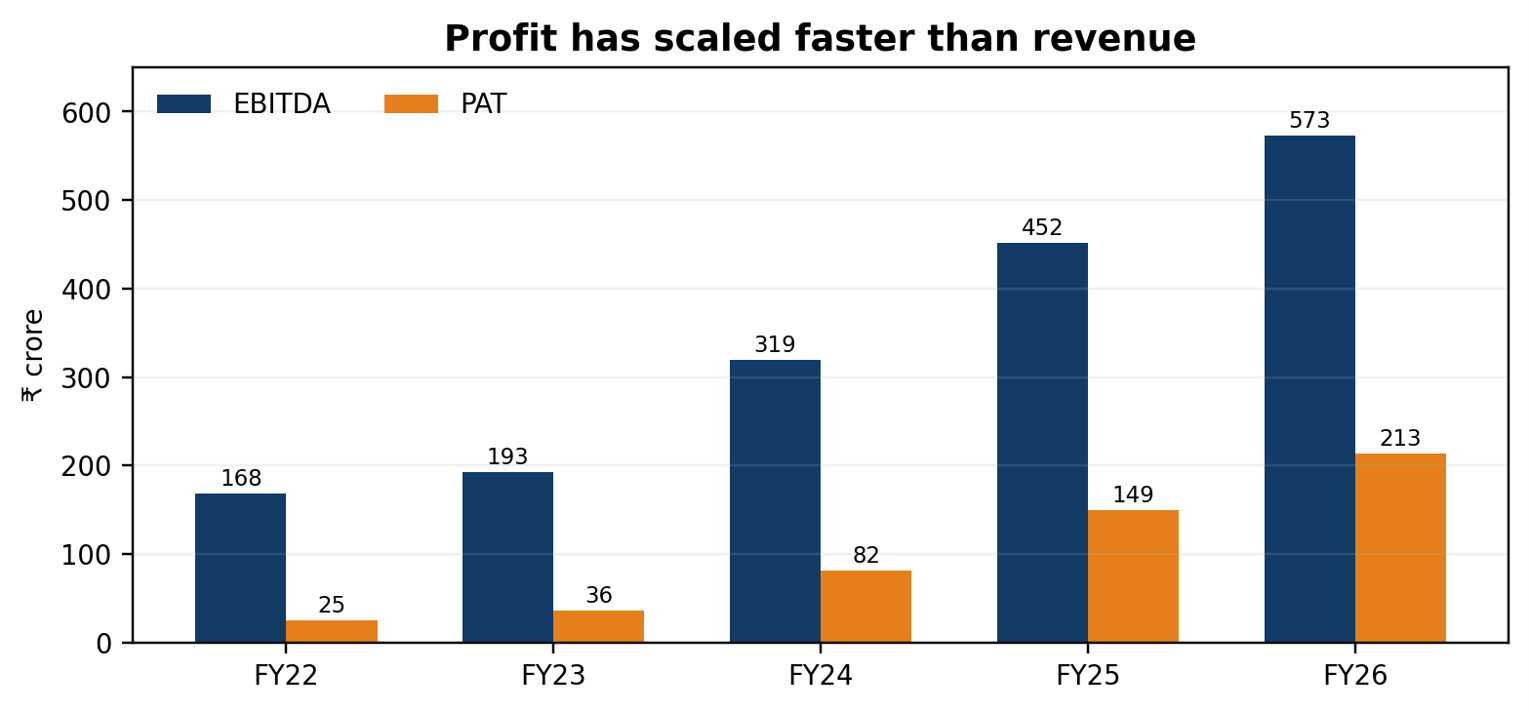
What the Five-Year Numbers Are Really Saying
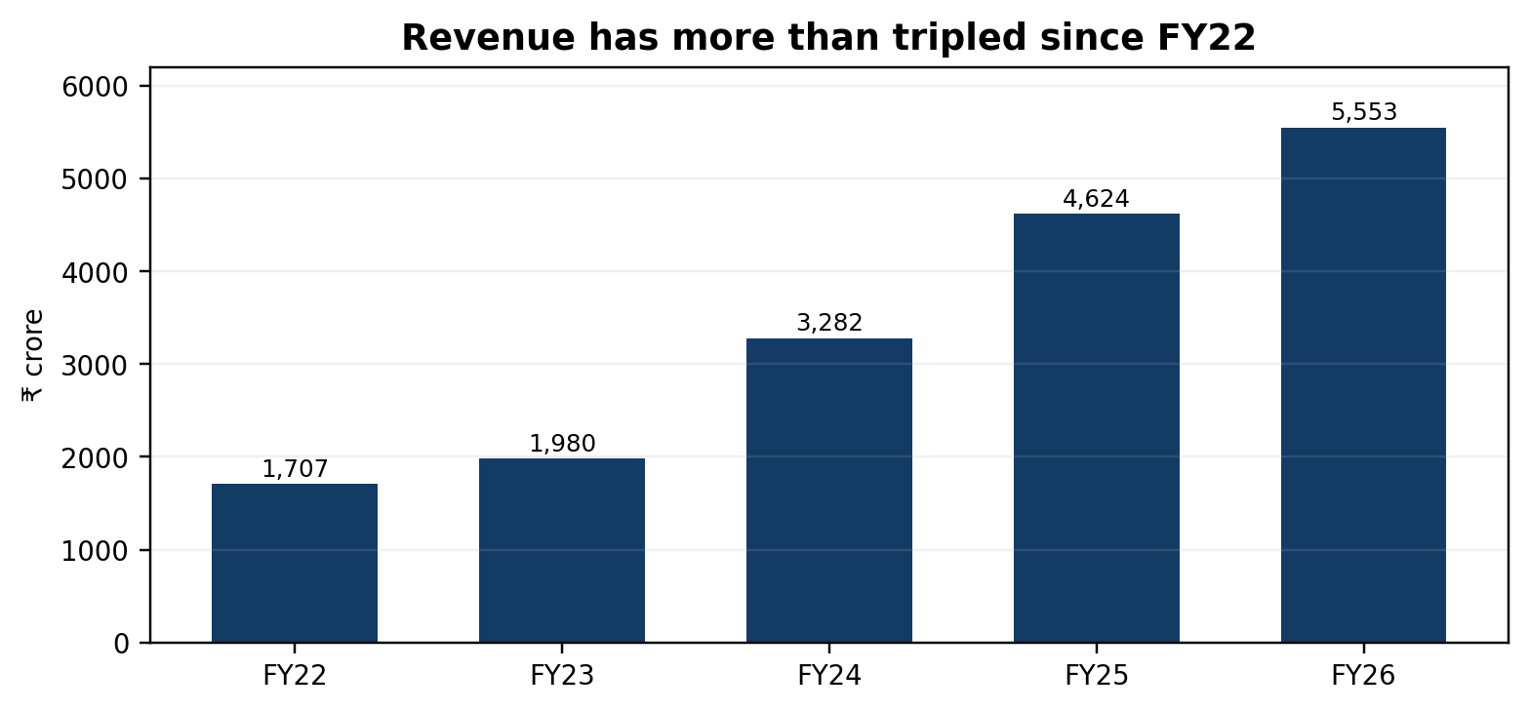
- Revenue scale is real: sales rose from ₹1,707 Cr in FY22 to ₹5,553 Cr in FY26. This is not a one-quarter order spike; the revenue base itself has changed.
- PAT grew much faster than sales because profitability normalised: PAT margin rose from 1.5% to 3.8% while finance cost fell as a share of revenue. That second lever cannot improve forever.
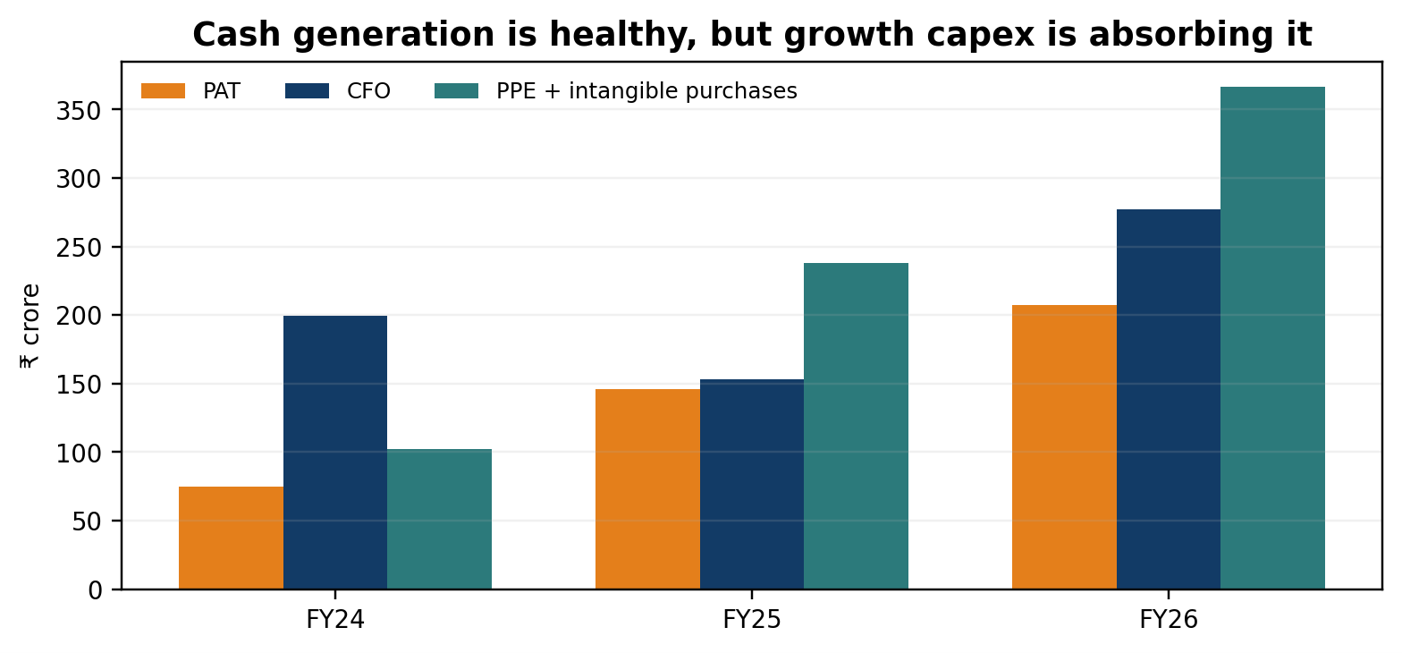
Operating cash flow has covered reported PAT reasonably well over FY24-FY26, but the company is in expansion mode. FY26 purchases of property, plant and equipment plus intangibles were about ₹366 Cr, above CFO of about ₹277 Cr. That is not automatically bad-capacity is being built-but it means free cash flow can remain weak even while earnings grow.
Peer Lens: There Is No Perfect Comparison
| Company | Best comparison | Key difference |
| Transrail Lighting | Closest focused T&D capability | More turnkey EPC + backward-integrated towers/conductors; higher order-book cover and lower current valuation. |
| KEC International | Mature global EPC reference | Much larger and more diversified; lower margins, heavier working-capital model. |
| Kalpataru Projects Intl. | Large diversified engineering reference | Global T&D plus multiple EPC verticals; mature scale. |
| Skipper | Manufacturing-heavy T&D platform | Engineering products dominate earnings; EPC is forward integration. |
