
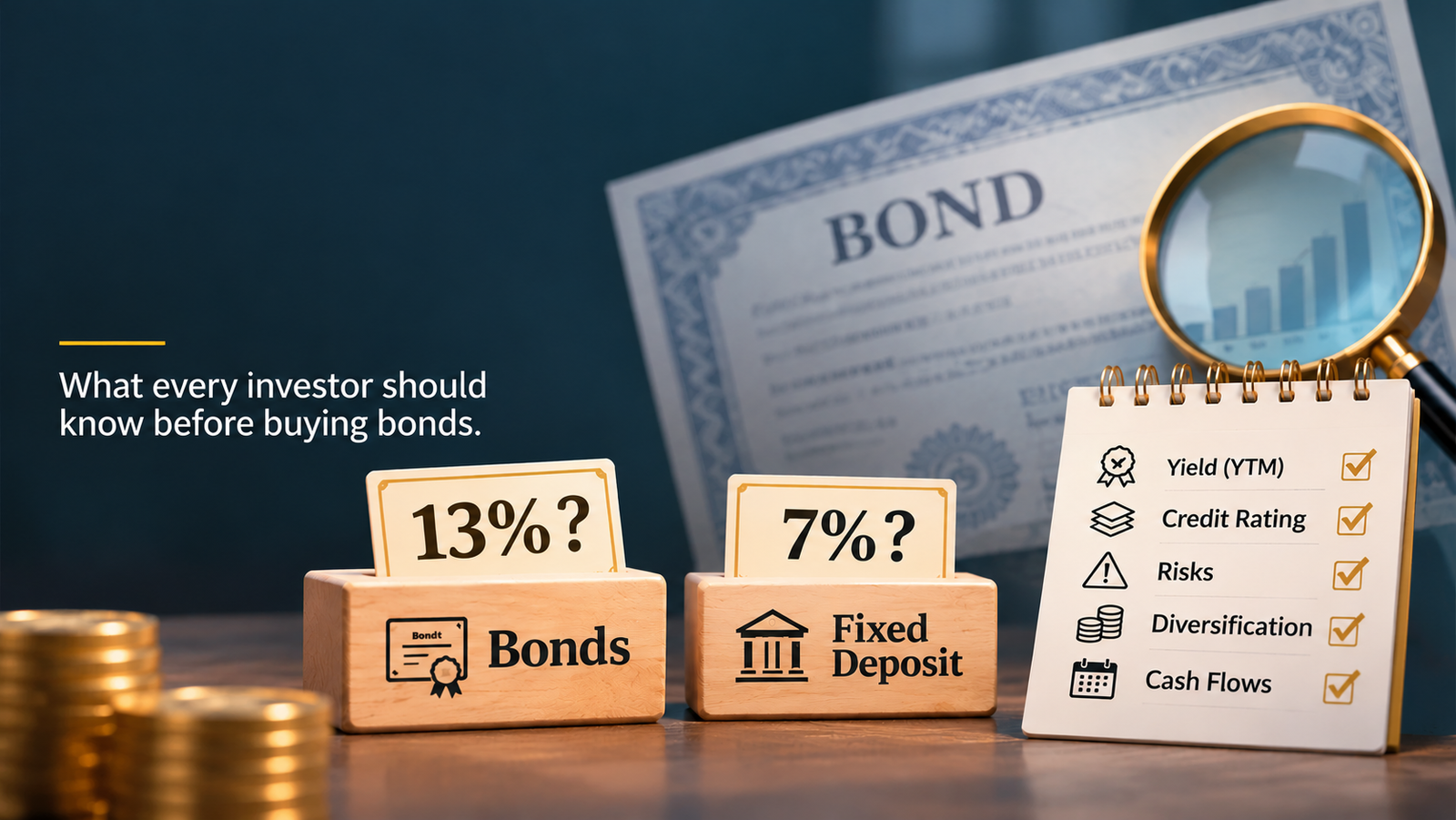
Imagine two investment opportunities: a bank fixed deposit offering 7% interest and a corporate bond advertising 13%.
The second looks more attractive. After all, both promise interest payments and eventual repayment of principal. Why accept 7% when 13% is available?
Because the comparison leaves out the most important question: What could prevent the investor from receiving the promised money?
A bond is not simply a fixed deposit with a higher interest rate. Its credit risk can be fundamentally different. Nor does the advertised coupon necessarily represent the return an investor earns.
Understanding bonds begins with three things: who owes the money, what price is being paid for the promised cash flows, and how much damage a default could cause.
1. What Is a Bond?
A bond is a loan made by an investor to an issuer. That issuer might be the Government of India, a state government, a municipality, or a company.
In return, the issuer promises payments under specified terms. Usually, these include interest at agreed intervals and repayment of principal on a maturity date. Some bonds instead accumulate their return and pay it at maturity.
Consider a company issuing a five-year bond with a ₹1,000 face value and a 9% annual coupon. The bond promises ₹90 in annual interest and ₹1,000 at maturity, provided the issuer fulfils its obligations.
Unlike a shareholder, a bondholder does not own part of the business. The investor has a contractual claim to payments, not a direct claim on the company’s future profit growth.
That makes two questions essential:
- Repayment: How likely is the issuer to pay interest and return the principal?
- Return: What will the investor actually earn at the price paid?
2. Coupon, Current Yield, and YTM: Three Different Numbers
Perhaps the costliest mistake in bond investing is assuming that a bond offering a 10% coupon necessarily earns its buyer 10%.
Three measures need to be separated:
- Coupon rate: Annual interest as a percentage of the bond’s face value.
- Current yield: Annual coupon divided by the bond’s purchase price.
- Yield to maturity (YTM): The annualised return implied by the purchase price and all scheduled payments through maturity, assuming those payments occur as promised.
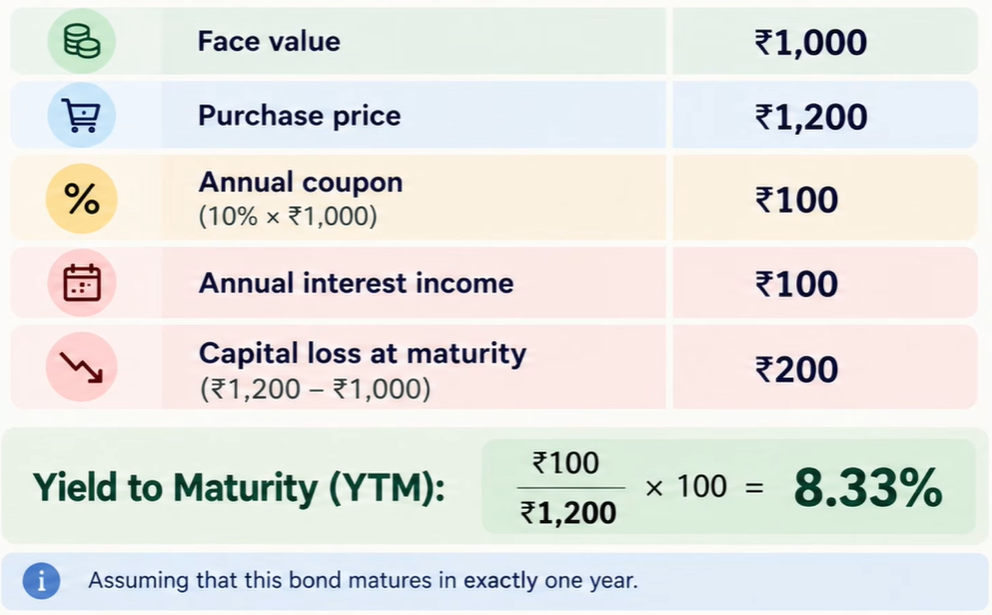
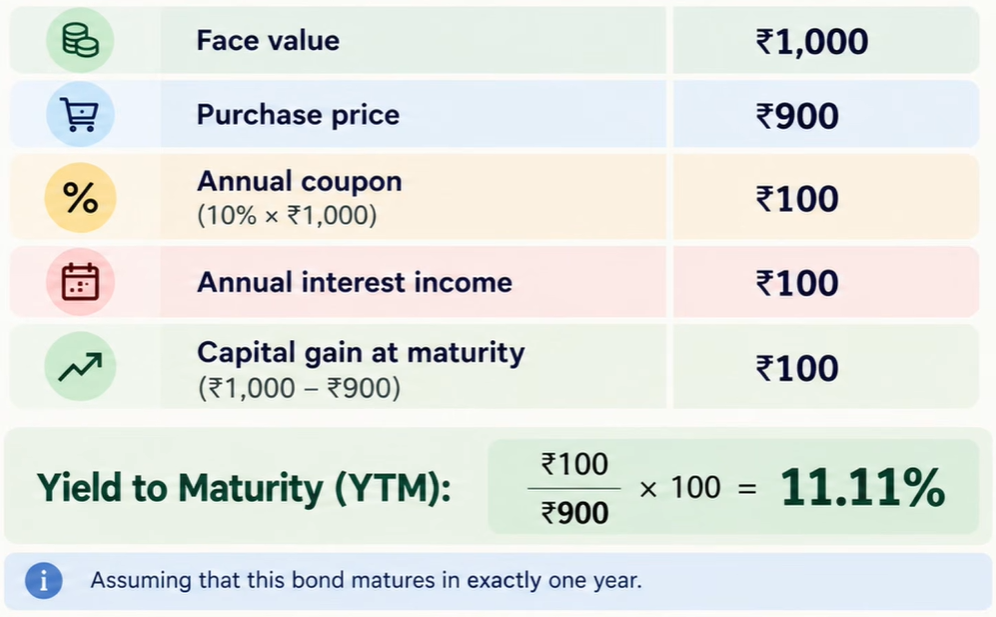
Consider a bond with a ₹1,000 face value, a ₹100 annual coupon, and exactly one year left to maturity. It will pay ₹100 in interest and redeem at ₹1,000 in one year.
| Purchase price | Coupon rate | Current yield | One-year YTM |
|---|---|---|---|
| ₹1,200 | 10% | 8.33% | −8.33% |
| ₹1,000 | 10% | 10.00% | 10.00% |
| ₹900 | 10% | 11.11% | 22.22% |
Illustrative calculations exclude accrued interest, costs and taxes, and assume full payment exactly one year later.
At ₹1,200, the buyer receives only ₹1,100 in total at maturity: ₹100 interest plus ₹1,000 principal. The resulting loss is ₹100, or 8.33% of the purchase price, despite the 10% coupon.
At ₹900, the investor receives the same ₹1,100 but makes ₹200 on ₹900 invested—a 22.22% one-year return.
For this one-year example:
YTM = (Interest + Redemption Value − Purchase Price) ÷ Purchase Price
For longer-maturity bonds with multiple payments, YTM requires discounting each future cash flow. Simply dividing the coupon by the market price gives current yield, not YTM.
Bond prices change as prevailing interest rates and perceptions of issuer creditworthiness change. Typically, when market interest rates rise, prices of existing fixed-rate bonds fall; when rates fall, those prices rise. Deteriorating credit quality can also push a bond’s price down.
The crucial implication is that a high YTM may signal opportunity—or the market’s fear of non-payment. Quoted YTM is not a guaranteed realised return.
3. Credit Ratings: Important, but Not Infallible
Credit ratings estimate an issuer’s ability to service debt. Agencies such as CRISIL, ICRA and India Ratings examine financial strength, cash flows, leverage and other risks.
The broad long-term rating hierarchy is:
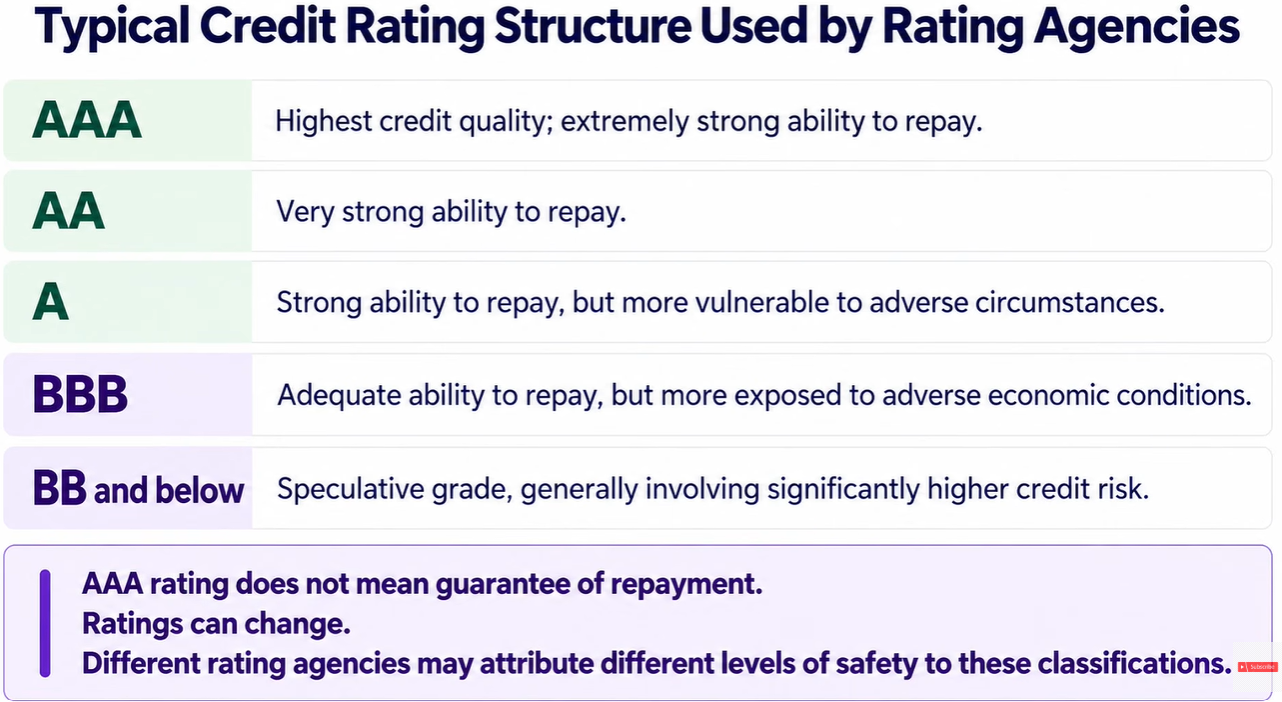
The precise interpretation and modifiers depend on the rating agency. In standard long-term scales, BBB− is the lowest investment-grade category.
Higher-rated borrowers generally access money at lower yields; weaker borrowers must often offer more to attract investors. Yet higher yield is useful only if it adequately compensates for the possibility of default and the amount that might be lost.
India’s IL&FS and Dewan Housing Finance Corporation (DHFL) crises provide a reminder. Debt linked to these groups had previously carried strong ratings, including AAA, before downgrades and defaults exposed investors to losses and prolonged uncertainty.
Ratings are therefore a starting point for credit assessment, not a promise of repayment. Investors should also examine whether a borrower produces enough cash to service debt, its refinancing needs, and the terms governing creditor recovery.
4. Why a Bond Portfolio Is Safer Than One Large Bet
Suppose an investor has ₹50 lakh to allocate to bonds. Putting the entire sum into one issuer offering a 12% yield exposes the whole amount to that borrower’s financial condition.
Spreading the money across five unrelated issuers at ₹10 lakh each reduces exposure to any single default. It does not eliminate losses, particularly if several borrowers face the same economic problems.
An illustrative mix might look like this:
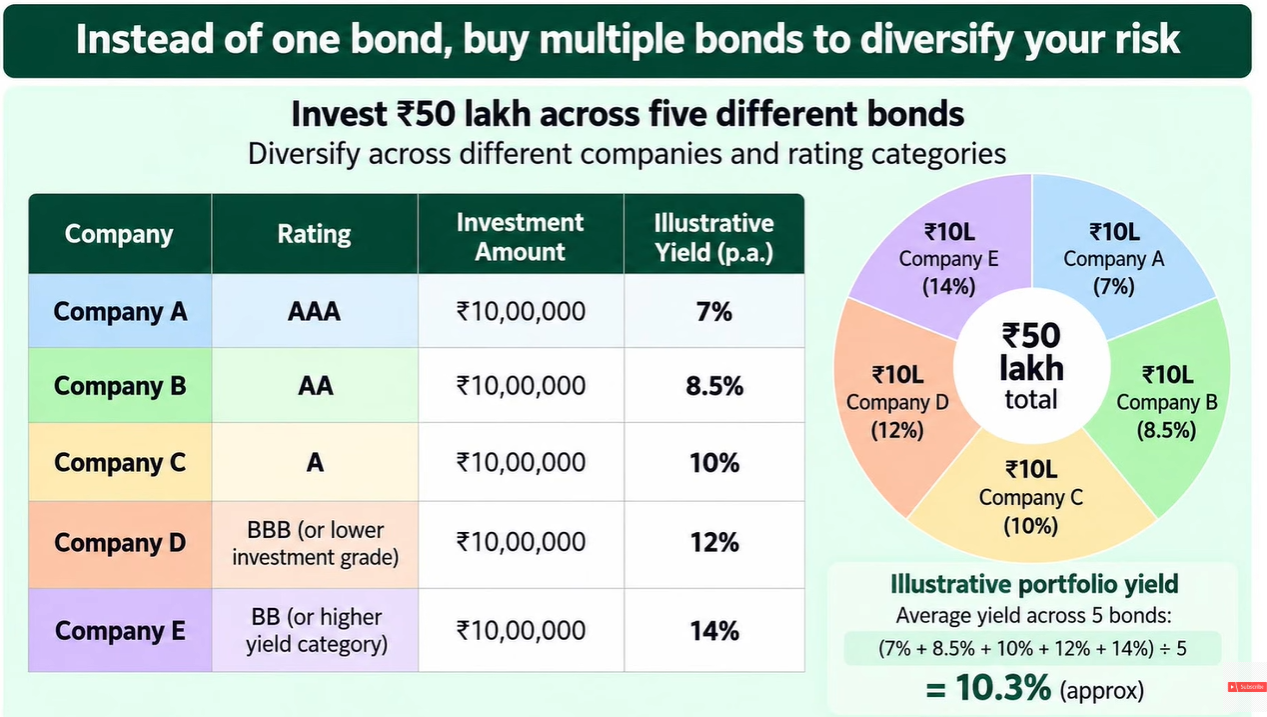
Such a portfolio could carry a weighted average of quoted YTMs of, say, 10.3%. But that is not a guaranteed 10.3% return or ₹5.15 lakh in annual cash interest. The BB-rated holding introduces significant speculative credit risk, and defaults could overwhelm the extra yield.
The illustration explains diversification; it is not a recommended allocation.
Importantly, diversification need not mean buying lower-rated bonds. Investors may choose several AAA-rated issuers instead, spreading exposure while remaining within a preferred credit-quality category.
The objective is to avoid allowing one company’s failure to cause disproportionate damage. Diversifying across issuers, industries, and repayment schedules is more meaningful than merely increasing the number of bonds owned.
5. Match Interest Payments to Income Needs
Bonds can also help investors organise their cash flows. Depending on the issue, interest may be paid monthly, quarterly, semi-annually or annually.
An investor seeking regular income can combine bonds with different payment dates. Those planning future expenditures can consider when principal is scheduled to mature.
This flexibility is useful, but a payment schedule is only as reliable as the issuer’s ability to honour it. A bond that promises monthly interest is not automatically safer than one paying annually.
6. How to Buy Bonds in India
Individual investors can access eligible bonds through brokers and registered bond platforms. Government securities can also be purchased through RBI Retail Direct.
A useful starting point is the bond’s International Securities Identification Number (ISIN). Each issue has its own identifier, allowing an investor to distinguish between securities from the same issuer that may have different coupons, maturity dates or repayment terms.
An investor can search that ISIN with a broker and check whether the bond is available to trade. Not every listed bond is offered on every platform, and limited trading activity may make buying or selling difficult.
Online bond platforms can improve access, but advertisements highlighting 11%, 13% or 14% deserve scrutiny. Investors should check whether the quoted number is a coupon or YTM, compare the actual purchase price and consider any brokerage, markup or embedded dealing spread.
It is also important to use appropriately registered intermediaries. SEBI maintains information on registered online bond platform providers and has warned against unregistered operators.
Convenience in purchasing a bond is not evidence of its credit quality.
7. The Questions to Ask Before Investing
Before committing money, a bond investor should be able to answer:
- Who is borrowing? What cash flows support repayment?
- What is the actual YTM? How does it differ from the coupon?
- What does the credit rating indicate? Has it recently changed?
- When is money due? What are the interest and maturity dates?
- How easily can the bond be sold? What price might an early exit involve?
- What is the after-tax outcome? Interest on ordinary taxable bonds is generally taxed at applicable rates; tax treatment of gains may differ.
- How concentrated is the position? What happens if this issuer defaults?
These questions force the investment decision to focus on repayment, price and risk rather than a headline yield.
The Bottom Line
The coupon is a promise. YTM is a calculation. The realised return is what the investor actually receives.
A high coupon does not guarantee a high return. A high YTM may compensate for risk—or may indicate that the market doubts the promised payments. Even a strong rating cannot eliminate uncertainty.
Bonds can be useful instruments for generating income and planning cash flows. But they should not be treated as interchangeable with fixed deposits, nor should a portfolio be built around whichever issuer advertises the highest rate.
A sound approach is to evaluate the borrower, understand the price and yield, and spread exposure intelligently.
The best bond portfolio is not necessarily the one promising the most interest. It is the one whose risks the investor understands and can afford to bear.
