

Why we are increasing exposure to gold, buying out-of-favour large-cap stocks, turning bullish on Indian IT and becoming increasingly selective about the broader market.
Prefer watching to reading?
For those interested in exploring our investment outlook in more detail, watch our latest video, where we discuss the rationale behind these portfolio changes, the market outlook for 2027, and the investment opportunities we are focusing on.
▶ Watch the full video: Our Investment Strategy for 2027
The Indian equity market appears to be at an interesting inflection point. Corporate earnings are improving, valuations remain relatively attractive, and several fundamentally strong businesses have delivered little to no stock price appreciation over the past four to five years.
At the same time, pockets of excessive valuations persist across small-cap stocks and global technology markets.
At Sana Securities, we believe the current environment presents an attractive opportunity to reposition portfolios heading into 2027.
The Market Outlook: Nifty at 30,000 in 2027?
In our earlier market outlook, when the Nifty was trading around 23,000, we anticipated an upside of approximately 20% over the following year.
With the index already having appreciated by around 11%, we are revising our expectations upwards.
Our conservative target for the Nifty by the end of 2027 is between 28,000 and 30,000.
The optimism stems primarily from the divergence between corporate earnings growth and market valuations.
Earnings are growing faster than valuations
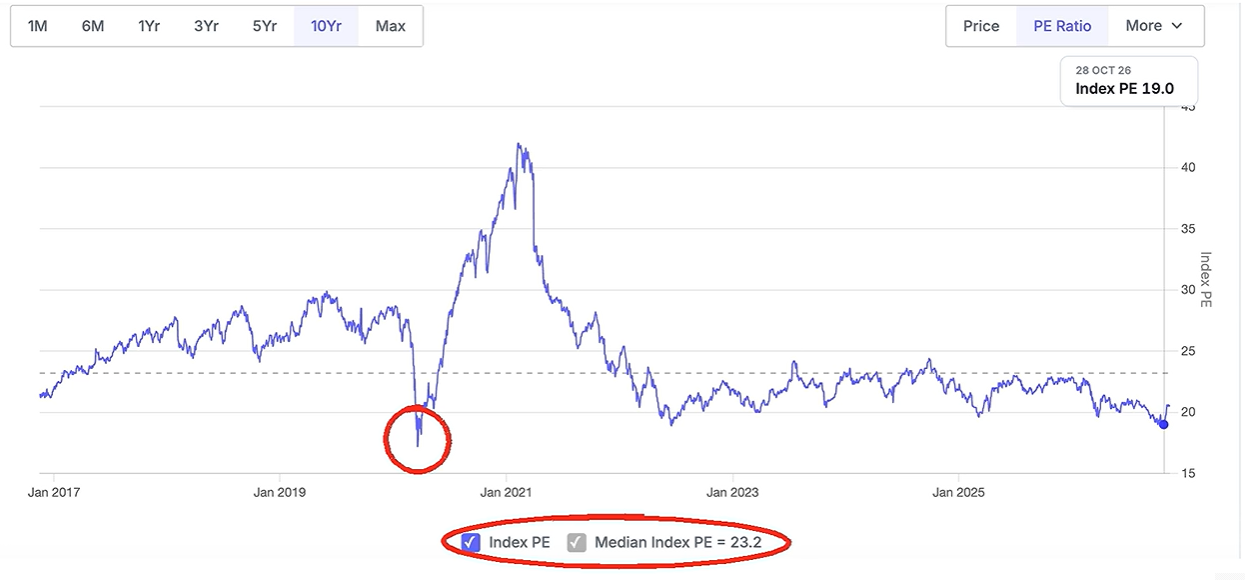
Consider the following data points:
- 19.1x — Nifty’s trailing P/E multiple towards the end of October, among its lowest levels in the past decade, excluding the COVID-19 crash.
- 20.1x — Nifty’s approximate trailing P/E multiple at the time of our recent market commentary.
- 15% — Nifty earnings growth during FY2026.
- 22% — Nifty earnings growth during the first six months of FY2027.
What makes the current environment particularly interesting is that corporate earnings have continued to improve without a proportionate increase in stock prices.
Even if the market moves higher, its valuation multiple could decline further, provided earnings continue to grow faster than prices.
Assuming earnings growth of 15% from here, we believe a Nifty valuation of approximately 31,000 would be reasonable.
The macroeconomic environment is improving
We believe several of the concerns that have weighed on equity markets, including interest rate hikes, are already reflected in market prices.
Another encouraging development is the decline in crude oil prices. Brent crude, which had reached approximately $124 per barrel, had fallen to around $92 at the time of our market commentary.
With additional supply expected to enter the market, we anticipate crude oil prices remaining closer to $90 per barrel.
While intermittent corrections are likely, and unforeseen events such as another major geopolitical conflict could alter the outlook, the broader trajectory for Indian equities remains encouraging.
Relative to the US equity market, we believe India offers a considerably more attractive valuation proposition.
Against this backdrop, we are focusing on four major portfolio changes for 2027.
01 | Increasing Allocation to Gold
Despite the sharp correction in gold prices, we remain extremely bullish on the asset class.
Gold had fallen from approximately $5,500 to $3,800–3,850 at the time of our commentary. We view this correction as an attractive opportunity to increase exposure rather than a reason to exit the asset class.
Our investment rationale rests on two major sources of demand.
Central bank demand remains structurally strong
In an increasingly uncertain world, gold is likely to become a more strategically important financial asset for central banks.
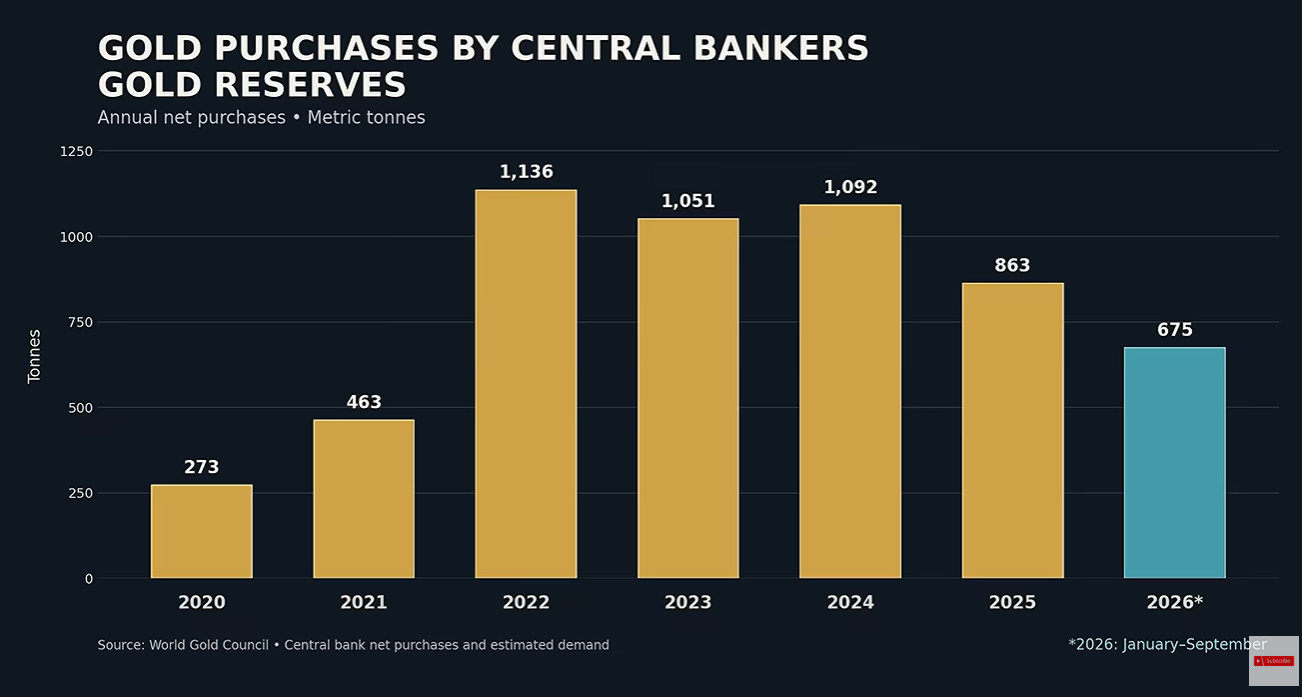
The change in purchasing behaviour over the past few years is particularly noteworthy:
- 400–500 tonnes: Annual central bank gold purchases approximately four years ago.
- 1,000 tonnes: Annual purchases in more recent years.
- 675 tonnes: Purchases during the first three quarters of the year under discussion.
We expect central bank purchases to remain strong, potentially exceeding 1,000 tonnes again over the full year.
As discussions around de-dollarisation gain momentum, countries could increasingly diversify their foreign exchange reserves by reducing their dependence on the US dollar and increasing their allocation to gold.
Private demand is equally important
Central banks are only one part of the gold demand story. A substantial portion of global demand comes from private consumption and investment, whether through physical gold or exchange-traded funds.
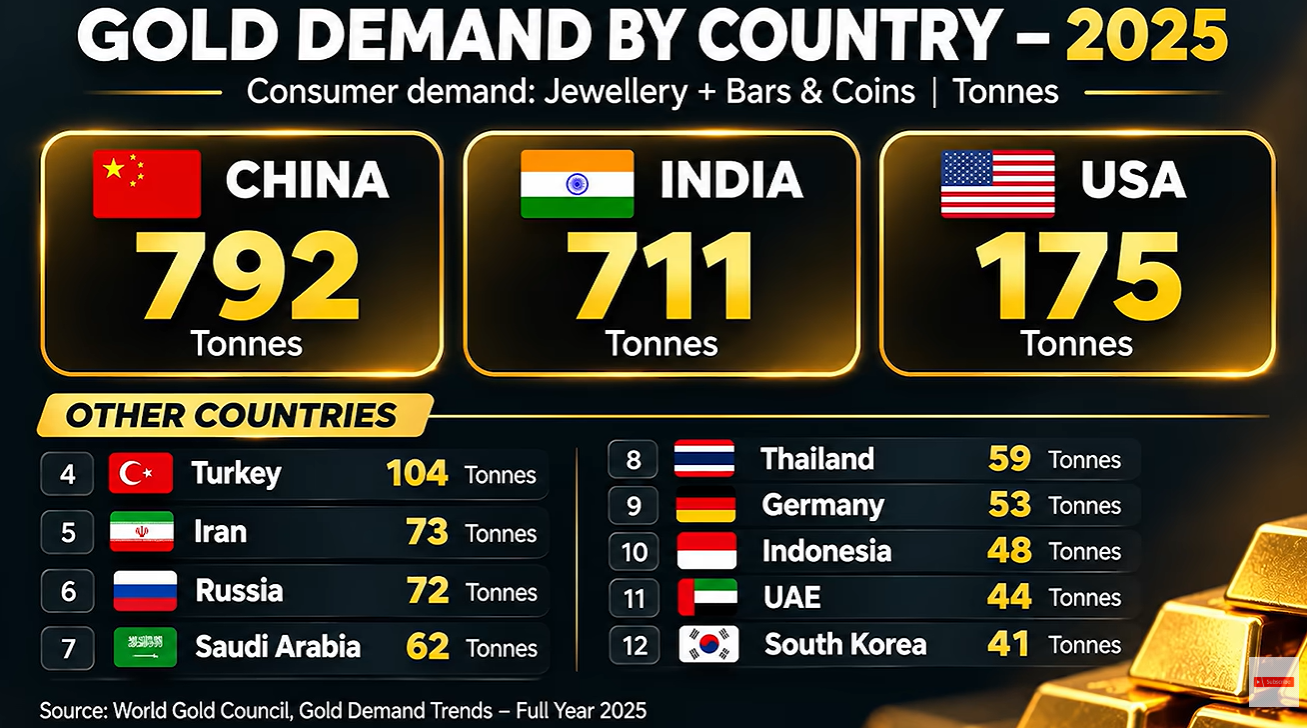
The scale of gold purchases across major consuming countries illustrates this:
China — approximately 800 tonnes
India — 721 tonnes
United States — approximately 175 tonnes
India and China remain particularly important sources of global gold demand. We expect lower prices to encourage further buying as investors recognise the value offered by the correction.
Where could gold prices go?
Historically, sharp corrections in gold have often been followed by recoveries towards previous highs, although prices may subsequently consolidate for extended periods.
We believe gold could gradually recover towards its previous peak of approximately $5,500.
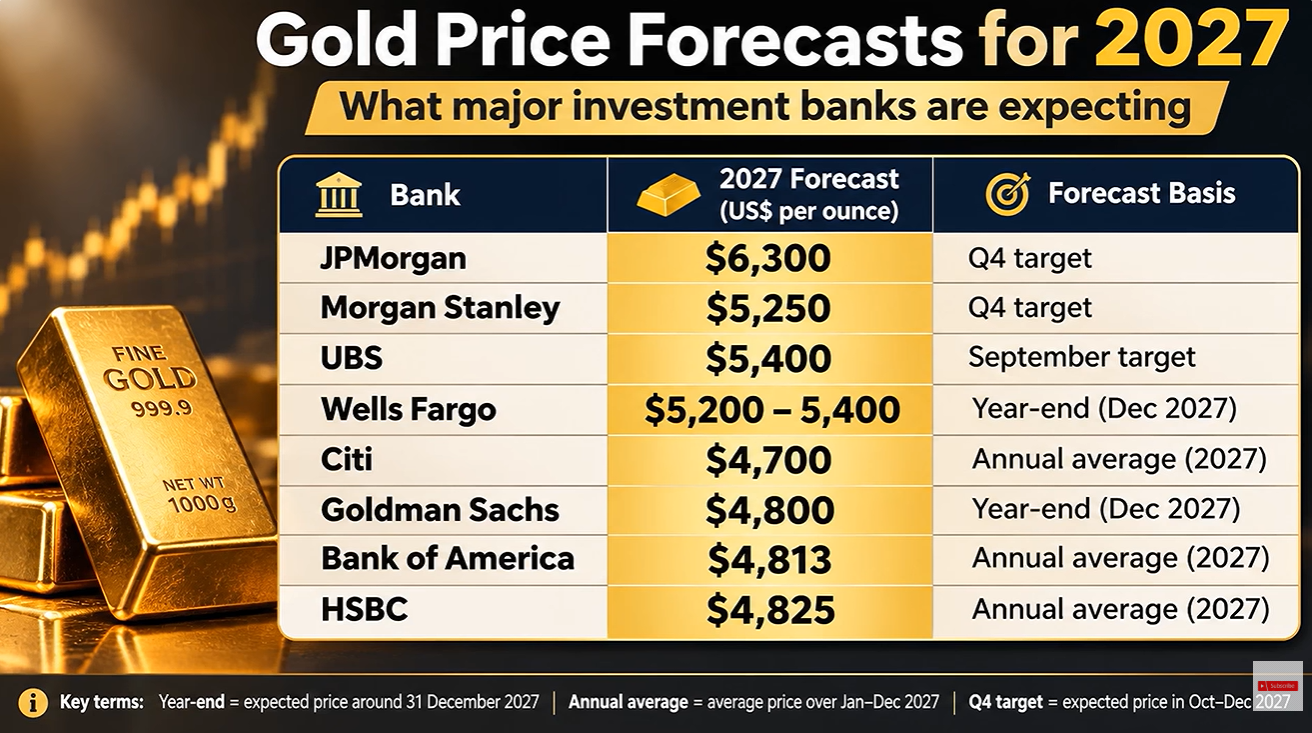
Major investment bank targets cited in our recent video also reflect a constructive outlook for FY2027:
- JPMorgan: $6,300
- Morgan Stanley: $5,250
Portfolio disclosure: Gold now accounts for approximately 28% of the personal portfolio discussed in our recent video — the highest allocation to gold in that portfolio to date.
02 | Buying Unloved Large-Cap Stocks
One of our strongest investment preferences heading into 2027 is for large-cap businesses that have fallen out of favour with investors.
Following a period of limited buying after February, equity purchases resumed aggressively in October, with a particular emphasis on large-cap companies.
We are especially interested in businesses that have delivered little stock price appreciation over the past four to five years, despite improving earnings or identifiable reasons for temporary weakness in profitability.
Tata Motors Passenger Vehicles: A Contrarian Opportunity
Tata Motors Passenger Vehicles is one of the more contrarian investments discussed in our portfolio strategy.
The company has faced a series of significant challenges, particularly within its Jaguar Land Rover (JLR) business.
Several adverse developments have affected its performance:
- Production disruptions following a major cyberattack.
- A fire at one of its key suppliers.
- US tariffs affecting vehicle sales.
- The discontinuation of existing Jaguar models ahead of the brand’s transition to an all-electric offering.
Virtually everything that could have gone wrong for the business appears to have gone wrong.
Yet, despite these operating challenges, the company’s financial position remains considerably stronger than it has been in many years. Its cash holdings substantially offset its outstanding debt, providing financial flexibility.
Jaguar’s bold reinvention
Jaguar’s decision to discontinue its existing models and reposition itself as an all-electric luxury car manufacturer represents an exceptionally bold strategic move.
At its peak in 2018–19, Jaguar accounted for approximately 30% of JLR’s revenue. Meanwhile, JLR itself contributes around 80% of Tata Motors Passenger Vehicles’ revenue.
The company is no longer simply attempting to retain its existing customer base. Instead, it is targeting a more premium segment of the luxury automobile market, competing for customers who might otherwise consider brands such as Ferrari and Bentley.

Its unconventional new design makes the outcome particularly difficult to predict.
The strategy could redefine Jaguar’s position in the luxury automobile market, or it could fail to generate the anticipated customer response.
It is precisely this combination of uncertainty, an improved financial position and the potential for a meaningful business recovery that makes the investment interesting.
Other large-cap opportunities
Beyond Tata Motors Passenger Vehicles, we remain constructive on several established businesses, including:
- HDFC Bank
- Zydus Lifesciences
- Asian Paints
- Infosys
- Tata Consultancy Services
Rather than chasing companies that have already experienced substantial stock price appreciation, our preference is to identify established businesses where market expectations remain subdued.
03 | Turning Aggressively Bullish on Indian IT
Perhaps one of the most contrarian elements of our investment strategy for 2027 is our increasingly bullish stance on Indian IT services companies, particularly Infosys and Tata Consultancy Services.
The prevailing market narrative suggests that artificial intelligence could significantly disrupt traditional IT services businesses.
We view the opportunity differently.
AI as a technology versus AI as an investment
There is an important distinction between believing in the transformative potential of artificial intelligence and believing that the prevailing valuations of AI companies are justified.
We believe the AI ecosystem is experiencing considerable valuation excesses. Companies such as Nvidia could, in our assessment, warrant valuations 40–50% below the levels discussed in our recent market commentary.
However, this does not mean that AI lacks technological or commercial relevance.
Much like computers and internet search transformed the way people worked, artificial intelligence will become increasingly integrated into everyday life.
Certain jobs will disappear, while new ones will emerge.
The fundamental question for investors is not whether AI will succeed as a technology, but which companies will ultimately benefit from its widespread adoption.
The opportunity lies in AI implementation
We believe companies responsible for implementing artificial intelligence across enterprises could emerge as significant beneficiaries.
Indian IT services companies, including Infosys and TCS, are already receiving orders related to AI implementation.
However, investors must distinguish between the total contract value announced by these businesses and the revenue that eventually appears in their financial statements.
Contracts take time to translate into recognised revenue. Consequently, the financial benefits of AI-related orders may become visible gradually.
We also believe that the intense enthusiasm surrounding artificial intelligence could persist ahead of major anticipated IPOs, including that of Anthropic.
As the initial investment frenzy subsides and valuations normalise, the opportunity for established technology implementation businesses could become increasingly apparent.
Our bullishness on Indian IT is not based on the failure of artificial intelligence. It is based on the opportunity created by its adoption and implementation.
04 | Becoming More Selective About Mid-Caps and Small-Caps
While we remain optimistic about Indian equities, that optimism does not extend uniformly across every segment of the market.
We have become increasingly selective about mid-cap businesses and remain broadly cautious about small-cap stocks.
Mid-caps: Selective opportunities remain
Although exposure to certain mid-cap companies has been reduced, we continue to identify individual businesses that offer attractive investment opportunities.
At Sana Securities, we have published a dedicated research report covering nine mid-cap stocks that we find particularly interesting.
We intend to revisit these companies in a future video, examining their performance relative to the prices at which they were originally recommended.
Small-caps: Valuation concerns persist
Despite the moderation in returns following the extraordinary small-cap rally towards the end of 2024, we believe considerable valuation froth remains within this segment.
One observation that investors often overlook is the difference between the long-term performance of mid-cap and small-cap investments.
In our assessment, mid-cap stocks generally offer a stronger long-term return proposition than small-cap stocks over an eight-to-ten-year investment horizon.
However, there are occasional periods when small-cap stocks dramatically outperform the broader market.
These exceptional periods often encourage investors to increase their exposure to small-caps, sometimes at the expense of mid-cap allocations.
We prefer the opposite approach: a higher allocation to mid-caps and a relatively smaller allocation to small-caps over longer investment horizons.
An Additional Change: Moving Capital From the US to India
Another significant portfolio decision has been to reduce exposure to US equities.
The capital previously invested in the S&P 500, as discussed in our recent video, has been brought back to India.
There are two principal reasons behind this decision:
Relative valuations: Many US equities are trading at valuations that, in our assessment, leave limited room for attractive future returns. Indian equities currently offer a more compelling alternative.
Currency outlook: We believe the US dollar could depreciate against the Indian rupee going forward.
While the currency outlook is a contributing factor, the primary driver of this decision remains the difference in equity valuations between the two markets.
How Should Long-Term Investors Structure Their Portfolios?
Based on our experience reviewing investor portfolios, we believe investors can benefit from distinguishing between the role of systematic investment plans (SIPs) and direct equity investments.
For investors with an eight-to-ten-year investment horizon, an indicative SIP allocation could be structured around the following:
40–50% — Mid-cap funds
20–25% — Small-cap funds
Approximately 20% — Gold
Remaining allocation — Multi-cap or large-cap funds
Our preference is for actively managed funds, particularly in the mid-cap and small-cap segments.
For large-cap exposure, investors who are comfortable selecting individual stocks can consider building positions directly rather than paying fund management expenses.
The idea is to identify established companies whose stock prices have remained stagnant for several years, despite improving earnings or temporary business challenges that have the potential to reverse.
Companies such as HDFC Bank, Asian Paints, Infosys and TCS illustrate the nature of the opportunities we are currently examining.
The Bottom Line
Our investment strategy for 2027 is increasingly focused on areas where valuations have become attractive and market expectations remain subdued.
Gold: Increasing exposure following the sharp price correction.
Large-cap stocks: Accumulating established businesses that have fallen out of favour.
Indian IT: Positioning for the long-term opportunity in AI implementation.
Mid-caps and small-caps: Remaining selective and avoiding pockets of excessive valuation.
US equities: Preferring Indian equities on relative valuation grounds.
With improving corporate earnings, relatively attractive equity valuations and moderating crude oil prices, we believe the outlook for Indian markets remains encouraging.
The best opportunities heading into 2027 may not necessarily lie in the businesses attracting the greatest investor enthusiasm today. They may instead lie in established businesses that investors have spent the past several years overlooking.
— Sana Securities
