
Suppose an investor has ten years to invest.
Historical data shows that mid-cap and small-cap indices have delivered significantly better returns than large-cap indices over the past decade.
This raises an interesting question: If mid-cap and small-cap funds have historically generated superior long-term returns, why should an investor allocate money to large-cap funds at all?
The question has merit.
Consider the ten-year returns of three major Indian equity indices discussed in the analysis.
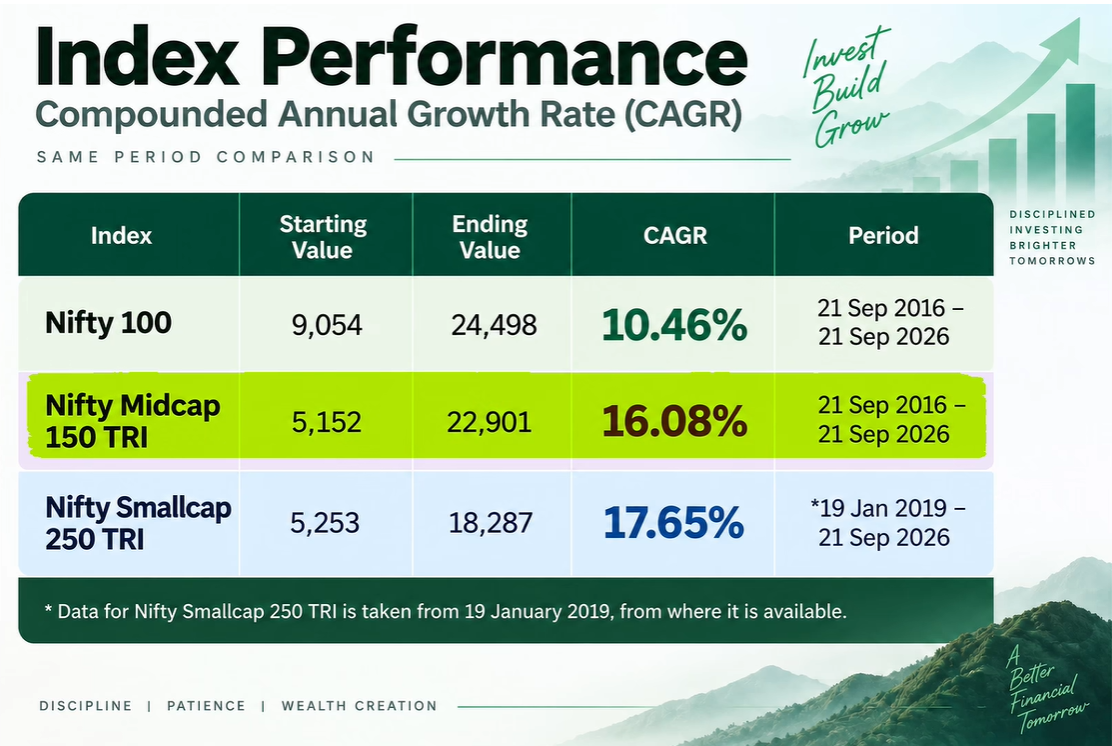
These are Total Return Indices (TRI), meaning dividends are accounted for alongside the effects of corporate actions such as bonuses and stock splits.
The performance difference is substantial.
But the decision to invest entirely in mid-caps and small-caps depends on something more important than historical returns.
It depends on whether the investor can remain invested when the market behaves very differently from what was expected.
1. Two Questions Every Long-Term Investor Must Answer
Before building an exclusively mid-cap and small-cap portfolio, investors must answer two questions.
Can you withstand a 40–50% market decline?
Mid-cap and small-cap funds can experience extraordinarily sharp corrections.
Declines of 40–50%, or even more, are not unusual over extended market cycles. Such corrections have occurred roughly once every ten to twelve years, and similar episodes could occur again.
DSP Small Cap Fund once highlighted in an advertisement that its portfolio had fallen 62% from its peak.
Consider what this means in practice.
An investor with ₹1 crore invested could suddenly find that portfolio worth only ₹40–45 lakh.
Regardless of net worth or investment experience, watching such a large amount of wealth disappear can be psychologically difficult.
Most investors believe they can tolerate volatility until they experience it.
The difficulty is not understanding that markets fluctuate. It is remaining committed to an investment strategy when a substantial portion of the portfolio’s value has disappeared.
Can you stop watching the market every day?
The second challenge is equally important.
There will be periods when large-cap funds outperform mid-cap and small-cap funds.
These periods may last two or three consecutive years, with large-caps outperforming by as much as 8–10 percentage points.
During such phases, market commentary will increasingly favour large-cap stocks.
Investors who constantly monitor daily returns may begin questioning their original decisions.
After two or three years of underperformance, even someone who initially intended to invest for ten years may be tempted to abandon the strategy.
This is why the ability to avoid reacting to daily market movements becomes essential.
A ten-year investment horizon is useful only when the investor has the discipline to remain invested for those ten years.
Many investors may confidently answer yes to both questions. But far fewer will be able to demonstrate that conviction during a severe market correction.
For those who genuinely possess the required temperament, an exclusively mid-cap and small-cap portfolio presents an interesting long-term opportunity, particularly through SIPs and for younger investors.
2. Building a High-Risk, High-Reward Mutual Fund Portfolio
The proposed strategy focuses on four mutual funds: two mid-cap funds and two small-cap funds.
Although such a portfolio would ordinarily be described as high-risk and high-reward, the underlying argument is slightly different.
It is a portfolio designed to pursue higher long-term returns while accepting considerable volatility along the way.
The selection of funds is not based simply on identifying the four best historical performers.
Instead, the emphasis is on stock selection, sectoral diversification, differences between fund portfolios, and the investment approach of their respective fund managers.
Fund 1: Invesco India Mid Cap Fund
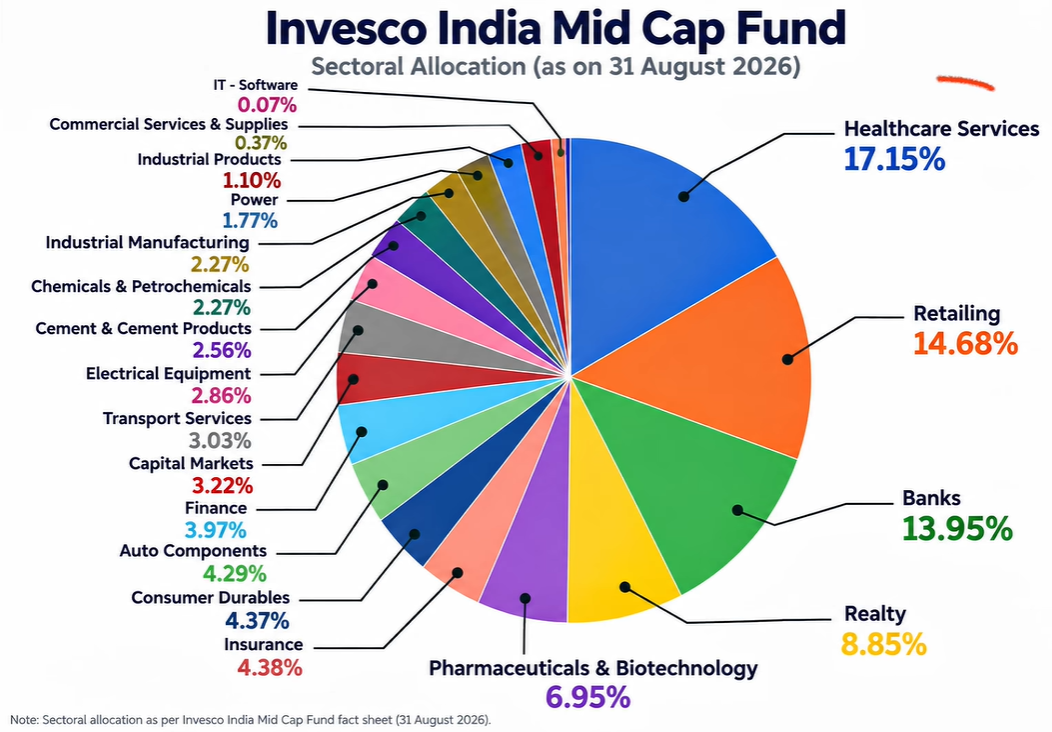
The first selection is Invesco India Mid Cap Fund.
This fund has demonstrated strong historical performance over several years and stands out for its stock selection and diversified sector exposure.
An interesting characteristic is the distribution of investments across industries.
The highest sector allocation in the portfolio snapshot discussed is approximately 17.15%.
This indicates that the fund was not overwhelmingly dependent on any single industry.
A general principle of diversification is to avoid excessive concentration in individual stocks. Invesco’s portfolio illustrates a relatively balanced approach across sectors while maintaining meaningful stock-level conviction.
As of August 31, 2026, the fund held approximately 41 stocks.
The portfolio also contained businesses trading at relatively high price-to-earnings multiples.
Despite those valuations, the fund’s historical performance, stock selection, and fund management approach make it an important part of the proposed portfolio.
It is also worth noting that selecting mutual funds solely because they were the best performers over the preceding three years is not necessarily the preferred approach.
Funds ranked third, fourth, fifth, or sixth may subsequently move higher in performance rankings.
Invesco is an exception to that preference, given its sustained historical performance and the confidence placed in its investment approach.
Fund 2: Helios Mid Cap Fund
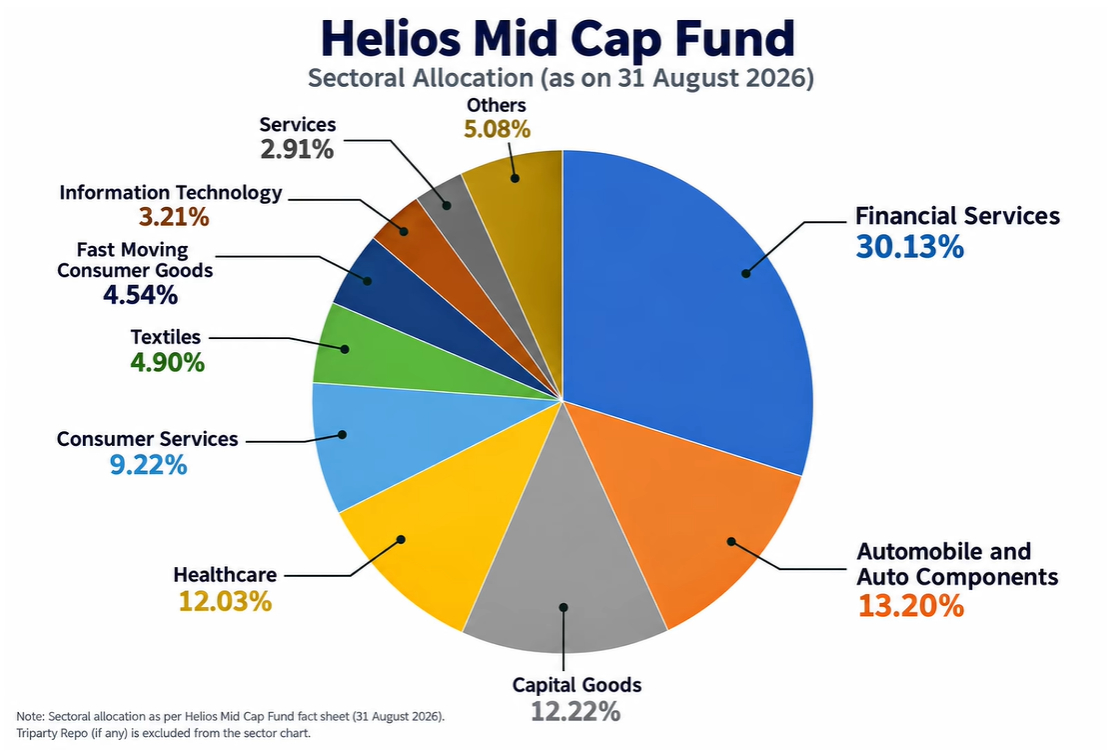
The second selection is Helios Mid Cap Fund.
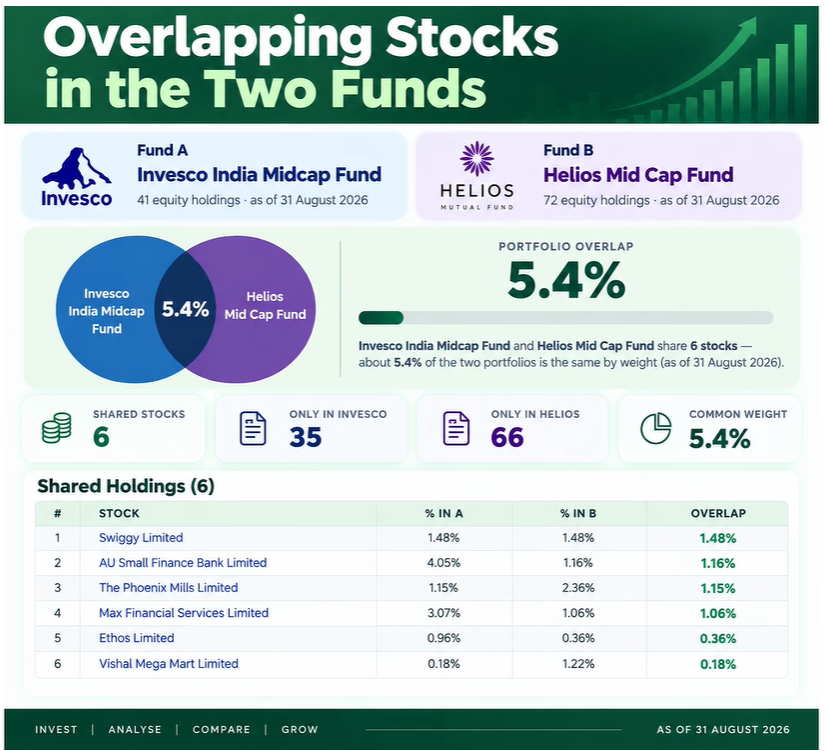
The primary reason for combining it with Invesco is the relatively low overlap between their underlying portfolios.
Two funds investing in the same market-cap category may own largely the same companies. In that case, investing in both may provide limited additional diversification.
Helios offers a different portfolio composition.
As of August 31, 2026:
| Portfolio Characteristic | Invesco Mid Cap | Helios Mid Cap |
|---|---|---|
| Approximate number of holdings | 41 | 71 |
| Sector concentration | Relatively diversified | Higher financial-services exposure |
| Portfolio overlap between the two | 5.4% | 5.4% |
The overlap comparison identified approximately 5.4% common exposure.
The overlapping stocks included Swiggy, AU Small Finance Bank, Phoenix Mills, Max Financial Services, Ethos, and Vishal Mega Mart.
Even these common positions represented relatively small percentages of the portfolios.
Another distinction is Helios’s relatively high allocation to financial services.
Despite holding more stocks than Invesco, its sector exposure was comparatively more concentrated.
Helios also places emphasis on identifying companies that could grow from smaller or mid-sized businesses into larger companies.
An interesting feature of its stated strategy is the focus on exiting positions at an appropriate time.
While every fund manager must make selling decisions, Helios explicitly incorporates disciplined exits into its investment philosophy.
The combination of Invesco and Helios therefore provides exposure to two meaningfully different mid-cap portfolios.
The objective is not merely to own two mid-cap funds, but to own two funds with different underlying businesses and investment approaches.
3. Moving to Small-Caps: Two Very Different Strategies
The small-cap allocation follows a similar principle.
Rather than selecting two funds with nearly identical portfolios, the idea is to combine funds with different approaches to portfolio construction.
Fund 3: Bandhan Small Cap Fund
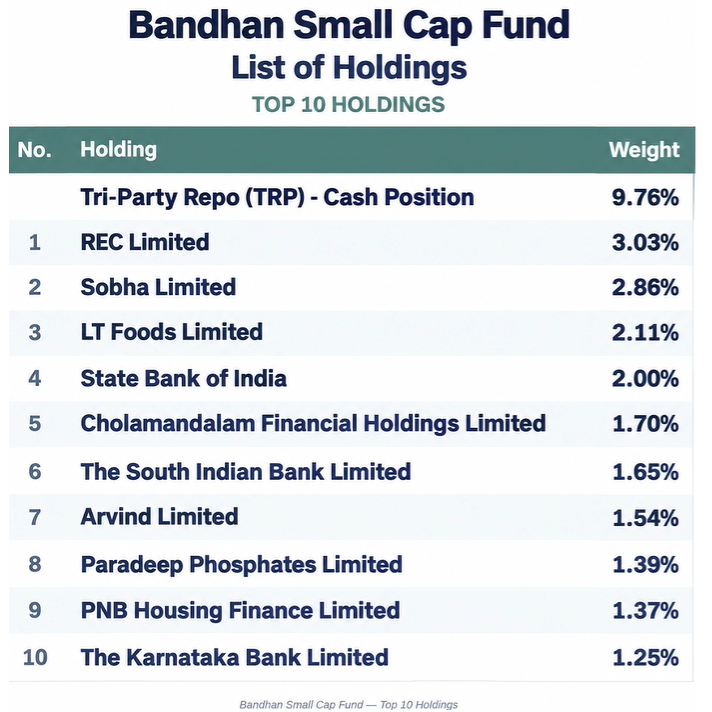
Bandhan Small Cap Fund stands out for an unusual reason: the sheer number of stocks it owns.
As of August 2026, the fund was described as holding approximately 265 stocks.
Its holdings typically number around 250, although the count varies between portfolio snapshots.
This is substantially more diversified by number of holdings than many other actively managed small-cap funds.
The individual stock allocations are also relatively modest.
REC Limited, for example, represented approximately 3.03% of the portfolio and was its largest holding in the snapshot discussed.
Other holdings included Sobha Limited, LT Foods, and Cholamandalam Financial Holdings.
The fund also maintained approximately 10% of its portfolio in cash, reflecting the expectation that more attractive opportunities to purchase small-cap stocks could emerge.
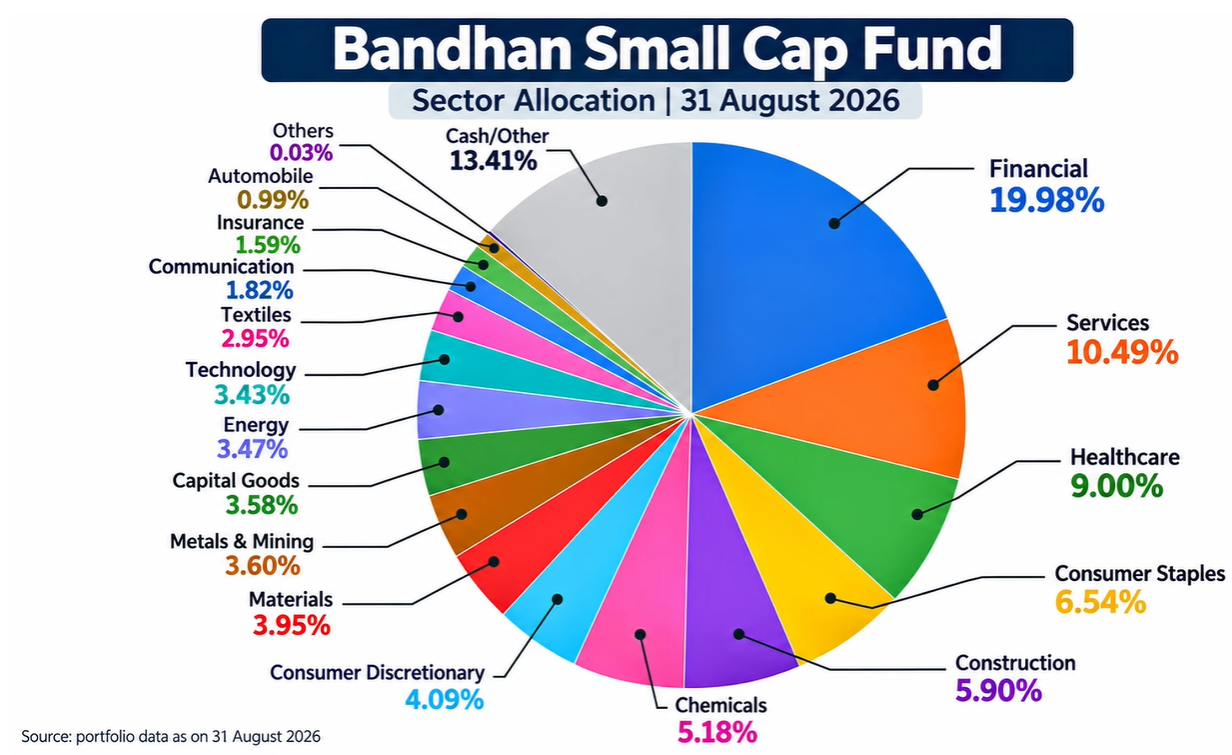
The fund’s broad diversification extends across numerous industries.
However, its most interesting feature may be its exposure to very small companies and its aggregate price-to-earnings multiple of approximately 17–18 times, compared with around 30–35 times for several other small-cap funds.
The relatively low valuation reflects its substantial exposure to smaller companies trading at lower earnings multiples.
Fund 4: DSP Small Cap Fund
The fourth selection is DSP Small Cap Fund.
Its portfolio-construction approach is very different from Bandhan’s.
While Bandhan typically holds approximately 250 stocks, DSP held around 61 stocks in the portfolio snapshot discussed.
This makes DSP a considerably more focused fund.
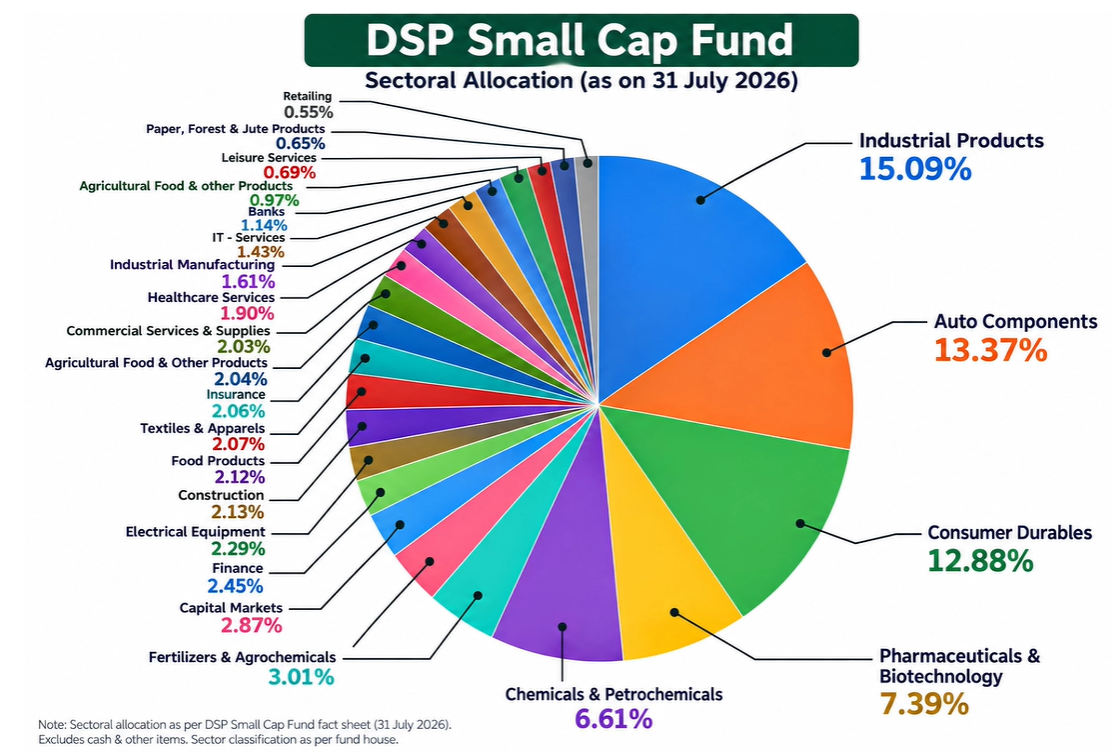
Its sectoral allocation is also interesting.
Industrial products, automobile components, pharmaceuticals, and biotechnology are among the areas highlighted as particularly attractive.
The fund’s exposure across these sectors is an important reason for its inclusion.
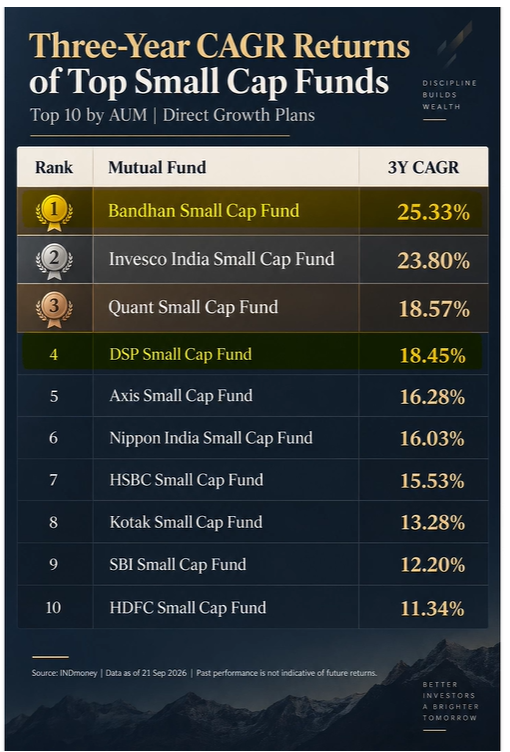
DSP has also been among the stronger-performing small-cap funds over the previous three years, ranking within the top five rather than necessarily being the single best performer.
This aligns with the preference for examining well-performing funds that are not always at the very top of historical return rankings.
Another consideration is its active portfolio management.
Changes in DSP’s holdings indicate an approach that involves adjusting positions and exiting investments as opportunities evolve.
Why combine Bandhan and DSP?
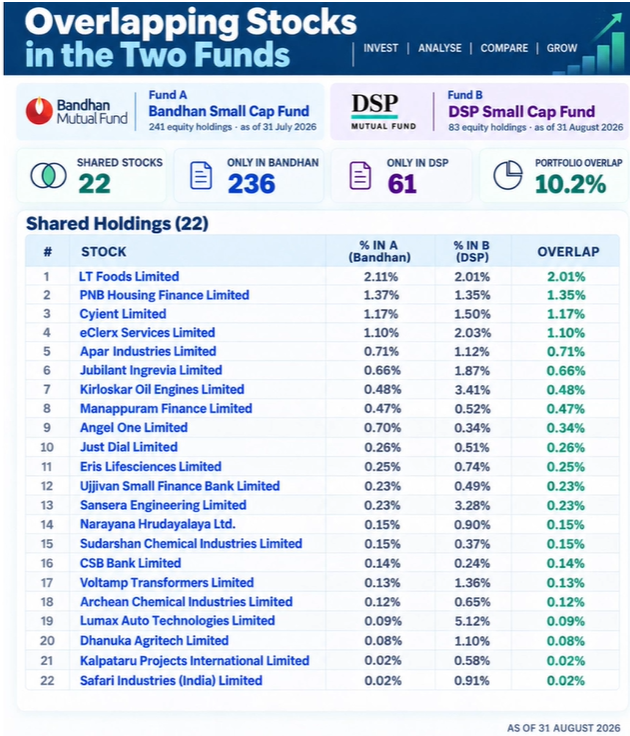
The portfolio overlap between Bandhan Small Cap Fund and DSP Small Cap Fund was approximately 10.2%.
Some overlap is natural, particularly when one fund owns more than 250 companies.
Nevertheless, their approaches are substantially different.
Bandhan spreads investments across a very large number of stocks, including smaller micro-cap businesses.
DSP maintains a comparatively focused portfolio with particular sector preferences.
Together, they provide two different approaches to participating in the small-cap market.
4. The Complete Four-Fund Portfolio
The proposed portfolio combines the following funds:
| Fund | Category | Primary Reason for Selection |
|---|---|---|
| Invesco India Mid Cap Fund | Mid-cap | Historical performance, stock selection, and sector diversification |
| Helios Mid Cap Fund | Mid-cap | Low overlap with Invesco and a different investment approach |
| Bandhan Small Cap Fund | Small-cap | Extensive stock diversification and micro-cap exposure |
| DSP Small Cap Fund | Small-cap | Focused stock selection and attractive sector exposure |
The key idea is diversification within the chosen market-cap categories.
Rather than combining funds based exclusively on historical returns, the selection considers what each fund owns and how the portfolios complement one another.
The resulting portfolio is aggressive, with substantial exposure to smaller companies.
Its potential attraction lies in long-term growth, while its greatest challenge remains the volatility investors must endure.
5. The Optional Fifth Investment: Gold
There is one additional asset worth considering alongside the four equity funds: gold.
The argument is not simply that gold could generate attractive long-term returns.
Even an expectation of 10–12% annual returns is not the central reason for including it.
The more important attraction is how gold can behave during major equity-market declines.
Consider the 2008 financial crisis.
The discussion highlighted that Indian equity markets declined approximately 55–60%, while gold appreciated around 22%.
An investor holding only equities could have experienced a dramatic fall in portfolio value.
However, an investor with approximately 25% allocated to gold would have benefited from the appreciation of that portion, reducing the overall decline.
The underlying view on gold remained positive.
For investors building an aggressive mid-cap and small-cap portfolio, the suggestion is to consider systematically investing in gold over the same ten-year horizon.
This would be separate from emergency savings and money required for expenses over the following year.
There is also another potential advantage.
During events such as the COVID-19 market crash or major geopolitical conflicts, gold may provide capital that can be gradually moved into equity funds after substantial declines.
This reallocation is optional.
It introduces an additional decision into a strategy otherwise designed around staying invested without reacting to market fluctuations.
For investors who prefer simplicity, continuing their existing SIPs without attempting such reallocations remains consistent with the long-term approach.
Gold is therefore an optional fifth allocation rather than another equity mutual fund.
6. The Most Important Variable: Investor Behaviour
The four-fund portfolio is built around a particular conviction: over a sufficiently long horizon, mid-cap and small-cap funds offer the potential to outperform a conventional portfolio combining large, mid, and small companies.
But the ultimate outcome depends on whether the investor can remain committed.
There may be severe market crashes.
There may be several years when large-cap funds perform better.
There may be periods when the chosen funds appear disappointing compared with competing schemes.
The central challenge is resisting the temptation to abandon a long-term plan because of short-term market behaviour.
The Bottom Line
The most difficult part of long-term investing is not choosing the funds. It is staying invested when those funds stop performing as expected.
Invesco India Mid Cap, Helios Mid Cap, Bandhan Small Cap, and DSP Small Cap represent four complementary approaches to investing in smaller Indian companies.
Their selection is based on portfolio composition, sector allocation, stock selection, and limited overlap rather than historical returns alone.
Gold provides an optional addition for investors seeking an asset that may behave differently during major equity-market corrections.
The long-term investment case is compelling to those willing to accept the volatility.
But the strategy ultimately requires one thing above everything else: the ability to remain invested for the entire journey, not merely the desire to earn the returns visible at the destination.
