
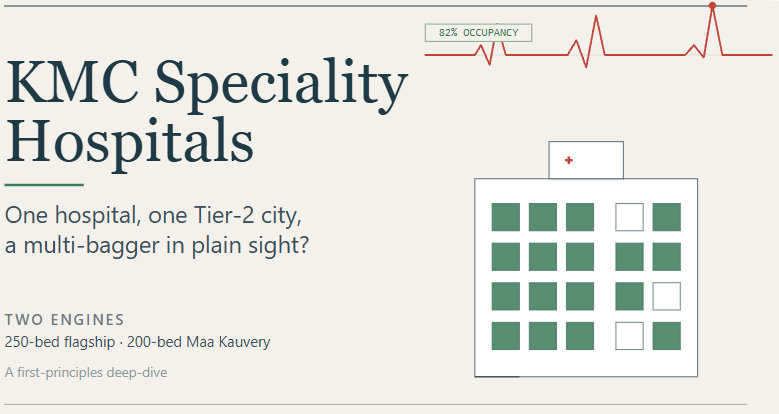
Most investors looking at Indian hospital stocks instinctively reach for Apollo, Max, Fortis, or Narayana. KMC Speciality Hospitals doesn’t make that list. It’s a sub-₹1,500 Cr market-cap small-cap that operates exactly one hospital – a 450-bed multi-specialty facility in Tiruchirapalli (Trichy), Tamil Nadu – and yet has compounded into one of the more interesting under-the-radar healthcare plays of the past few years.
At ~₹83 (early April 2026), the stock has rallied roughly +26% over the last year while the BSE 100 has barely moved, a P/B that ranges from 7.8x, and a P/E 39x
The Investment Thesis
KMC Speciality Hospitals is the listed Trichy flagship of the Kauvery Group – a single-asset, 450-bed Tier-2 multi-specialty hospital riding three structural Indian healthcare tailwinds: the Tier-2 capacity gap, insurance-led formalization, and the mother-and-child sub-segment boom. The numbers tell a clean story: revenue compounding at ~19% CAGR, EBITDA margin at 31.1% (top-quartile, on par with KIMS), occupancy at 82%, ARPOB growing 17% YoY, and an India Ratings upgrade to IND AA. The new 200-bed Maa Kauvery facility is the ramp engine for the next 2-3 years; the legacy 250-bed core is the cash cow.
A simpler scenario approach for KMC:
Bull case (Maa Kauvery ramps to 75% occupancy by FY28): FY28 revenue ~₹450 Cr, 30% EBITDA, ~₹85-90 Cr PAT. At 35x P/E → market cap ₹3,000 Cr → ~₹170/share. Upside ~100%.
Base case: FY28 revenue ~₹380 Cr, 27% EBITDA, ~₹65 Cr PAT. At 30x P/E → market cap ₹1,950 Cr → ~₹110/share. Upside ~30%.
Bear case (corporate guarantee invoked OR new wing under-ramps): FY28 revenue ~₹320 Cr, 22% EBITDA, ~₹40 Cr PAT. At 25x → market cap ₹1,000 Cr → ~₹56/share. Downside ~30%.
What KMC Actually Does
KMC Speciality Hospitals (India) Ltd is a 75% subsidiary of the Kauvery Group, the Tamil Nadu-headquartered hospital chain founded by Dr. S. Manivannan and Dr. S. Chandrakumar. The listed entity itself runs a single, 450-bed multi-specialty hospital in Trichy
The corporate history is a good lesson in how cap tables get built: Started as Advanced Medical Care in 1982, became Seahorse Hospitals Ltd in 1995, and was acquired by Sri Kauvery Medical Care (Trichy) Ltd in April 2008 — at which point it was renamed KMC Speciality Hospitals (India) Ltd. The Trichy hospital is the flagship from which the entire Kauvery brand grew.
The asset itself is divided into two sub-units:
1. The Original 250-Bed Multi-Specialty Hospital
Tertiary care across 35+ specialties — cardiology, neurosciences, gastroenterology, orthopedics, oncology, transplantation, IVF, dialysis. Centrally located in Trichy, it draws patients from over a 200 km catchment radius — a clinical hub for central Tamil Nadu. This is the legacy cash cow with mature occupancy and ARPOB.
2. The New 200-Bed Maa Kauvery Mother & Child Care Facility (operational from January 29, 2024)
This is the growth engine. A dedicated mother-and-child specialty facility – high-margin, less competitive in the local market, and structurally favorable on demographics. The whole story for the next 2 years is the ramp of these 200 beds.
So the listed entity is what hospital-sector investors call a single-asset, two-vertical tertiary-care play in a Tier-2 city – something between a regional flagship (like KIMS in Hyderabad) and a Tier-2 specialty franchise.
Why It Works
The Indian listed hospital sector delivered a 15.5% revenue CAGR and 25% EBITDA CAGR between FY20 and FY25, with sector EBITDA margins expanding ~780 bps. Equirus expects sector margins to stay at 22–25% through FY26–27, expanding to 25–27% by FY29 as new beds mature.
Three forces are converging — and KMC sits in the sweet spot of all three:
1. The Tier-2/3 healthcare gap. Top-tier Indian healthcare has historically been concentrated in metros. Tier-2 cities like Trichy have a structural shortage of tertiary-care capacity – and the patients who need it have been forced to travel to Chennai, Bengaluru, or Coimbatore. KMC closes that gap. This is the demand-supply mismatch trade – far more durable than a pricing-power thesis.
2. The insurance-led formalization wave. Health insurance penetration has gone from 17% to ~36% of Indians in roughly a decade. Government schemes (PM-JAY, Ayushman Bharat) covering 500 million people are pulling more patients into formal hospitals. KMC’s payor mix, like that of most regional hospitals, benefits from this directly.
3. The mother-and-child specialty boom. This is the highest-margin sub-segment in Indian hospital care, anchored by deeply non-discretionary spending. Rainbow Children’s trades at ~25x EV/EBITDA for a reason. KMC’s brand-new 200-bed Maa Kauvery facility is a direct play on this – and unlike Rainbow, it’s still in the early ramp phase where operating leverage is yet to fully kick in.
The Numbers
Pull the actual operating metrics:
| Metric | FY24 | FY25 | Q3 FY26 | Takeaway |
|---|---|---|---|---|
| Revenue | ₹177 Cr | ₹232 Cr (+31%) | ₹83.2 Cr (+33% YoY) | Highest revenue prints in the company’s history |
| EBITDA Margin | 26.74% | 24.56% | 31.1% | Margin compression in FY25 from new-wing ramp; now structurally expanding |
| PAT | ₹30.4 Cr | ₹21.4 Cr (−29%) | ₹13.7 Cr (+82.7% YoY) | The FY25 dip was the cost of growth — Q3 FY26 confirms recovery |
| PAT margin | ~17% | ~9% | 16.5% | Back to historical levels and rising |
| ARPOB | — | — | ₹31,481 (+17% YoY) | Pricing power without alienating the volume base |
| Occupancy | ~90%+ | — | 82% | Strong utilization — typical for established Tier-2 flagship |
| ROCE | — | — | 20.3% | Right in the sweet zone for hospital businesses |
| IPD volumes | 14,194 | — | +18% YoY | Volume-led growth — exactly what you want to see |
| Debt/EBITDA | — | 1.25x | 1.25x | Conservative leverage — IND AA rating from India Ratings (recent upgrade) |
Six-month commentary (H1FY26): Net sales ₹156.96 Cr (+33.5%), PAT ₹24.57 Cr (+26.7%).
The picture is unambiguous: revenue is compounding fast, the FY25 margin dip was temporary (new wing ramp-up cost), and Q3 FY26 has confirmed the operating leverage thesis is real. EBITDA margin at 31.1% genuinely puts KMC in the same league as KIMS (28-30%) — which is the gold standard among regional players — and ahead of Apollo/Fortis on margin if you isolate the hospital-only business.
The 5-year revenue CAGR of ~19% vs sector average ~13% confirms this isn’t a recent fluke — it’s structural.
How KMC Stacks Up Against Peers
The peer picture is critical because it tells you whether you’re paying a premium or a discount for the same operating quality:
| Hospital | EBITDA Margin | ARPOB | Occupancy | Trailing P/E |
|---|---|---|---|---|
| Apollo | 22-24% | ~₹55-60K | 67% | ~30x EV/EBITDA |
| Max Healthcare | 25%+ | ~₹77,900 | 76% | 80-100x P/E |
| Fortis | 18-20% | ~₹50K | 67% | ~35x EV/EBITDA |
| Narayana | 16-18% | ~₹35-40K | 75-80% | ~30x P/E |
| KIMS (regional comp) | 28-30% | ₹40-50K target | 70-75% | ~50x P/E |
| KMC Speciality | 31.1% (Q3) | ₹31,481 | 82% | ~36-43x |
KMC’s operating metrics put it in the top-quartile of Indian hospitals on margin and occupancy. ARPOB is lower than metro players (it’s a Tier-2 city — that’s the structural reality), but ARPOB is growing 17% YoY, which matters more than absolute level. Valuation looks reasonable when benchmarked correctly — not against Apollo’s diversified empire but against single-region specialty operators.
The Growth Triggers (Next 12-24 Months)
1. Maa Kauvery 200-bed ramp. This is the single biggest lever. The new wing went live Jan 29, 2024 and has only 8 quarters of operating history. Mother-and-child takes 3-5 years to fully ramp. If occupancy here follows the broader hospital pattern — going from 50% in Year 1 to 75%+ by Year 4 — you get meaningful operating leverage with no incremental capex.
2. ARPOB expansion. From ₹26,907 a year ago to ₹31,481 today — 17% growth. Drivers: better case mix (more high-acuity tertiary cases), better payor mix (more insurance, less government scheme), and rate hikes. This is the “case mix improvement” story: every additional rupee of ARPOB drops nearly 100% to gross margin given fixed-cost intensity.
3. The IND AA rating upgrade (recent). India Ratings upgraded KMC from IND A+ to IND AA — a meaningful signal of credit quality improvement. Lower borrowing costs going forward.
5. Operating leverage. Q3 FY26 EBITDA margin at 31.1% — compared to 24.56% in FY25 — is the single most important data point in the entire thesis. That kind of jump in 12 months tells you the new beds are converting from cost-burden to profit-engine in real time.
Where the Thesis Could Break (Risks You Must Own)
1. The corporate guarantee. This is the elephant in the room. In FY25, KMC provided a ₹98.57 Cr corporate guarantee for a loan availed by its holding company, Sri Kauvery Medical Care. That guarantee equals 60% of KMC’s tangible net worth as of March 31, 2025. Read carefully: the listed company is on the hook — guaranteeing the parent’s debt — for a sum that is six-tenths of its own equity base. If the parent stumbles, KMC pays.
2. Single-asset concentration. One hospital in one city. Any localized event (fire, regulatory action, clinical adverse event, a competitor opening a 500-bed hospital across the road) hits the entire P&L. This is a fundamentally different risk profile from Apollo or Max which can absorb shocks across geographies.
3. The valuation is not “cheap” by any honest measure. P/E somewhere between 36x and 61x depending on the trailing window. P/B of 7-11x. This is not a value stock — you’re paying for the growth ramp. The bull case requires the Maa Kauvery wing to genuinely scale and ARPOB expansion to continue. Miss either and the multiple compresses fast.
4. Government pricing pressure. Any move by the Clinical Establishments Act to cap private hospital pricing at CGHS rates — or any aggressive PM-JAY rate negotiation — directly hits ARPOB. Hospitals are price-takers when government rules change.
5. Promoter holding stable but no dividend. Promoters at 75%, but the company doesn’t pay dividends despite consistent profits. Cash gets reinvested. That’s defensible during a growth phase, but it does mean shareholders are betting entirely on capital appreciation.
